


Mobile home transport services are the chain of work that moves a manufactured home from one lot to another and leaves it legal, level and livable: permitting, disconnection, transport, set, anchoring, utility hookup and inspection. Most companies sell one link of that chain. We run all of it on one schedule with one point of contact, which is why the handoffs that usually cost homeowners weeks never happen.
Table of Contents
This page is the overview. It explains what each of our mobile home transport services covers, what decides the price, how a job is sequenced, and where to read more about any part of the work. If you already know what you need, request a quote and we will price it against your address and home type.
What mobile home transport services actually cover
Most people start looking for mobile home transport services when something is already urgent: a closing date, a park deadline, a home bought at auction, or a job offer two states away. The useful answer is not a truck size. It is a sequence, and knowing the sequence is what stops one move turning into three contractors who each blame the other two. That is also why we sell mobile home transport services as one scope rather than a menu of separate jobs.
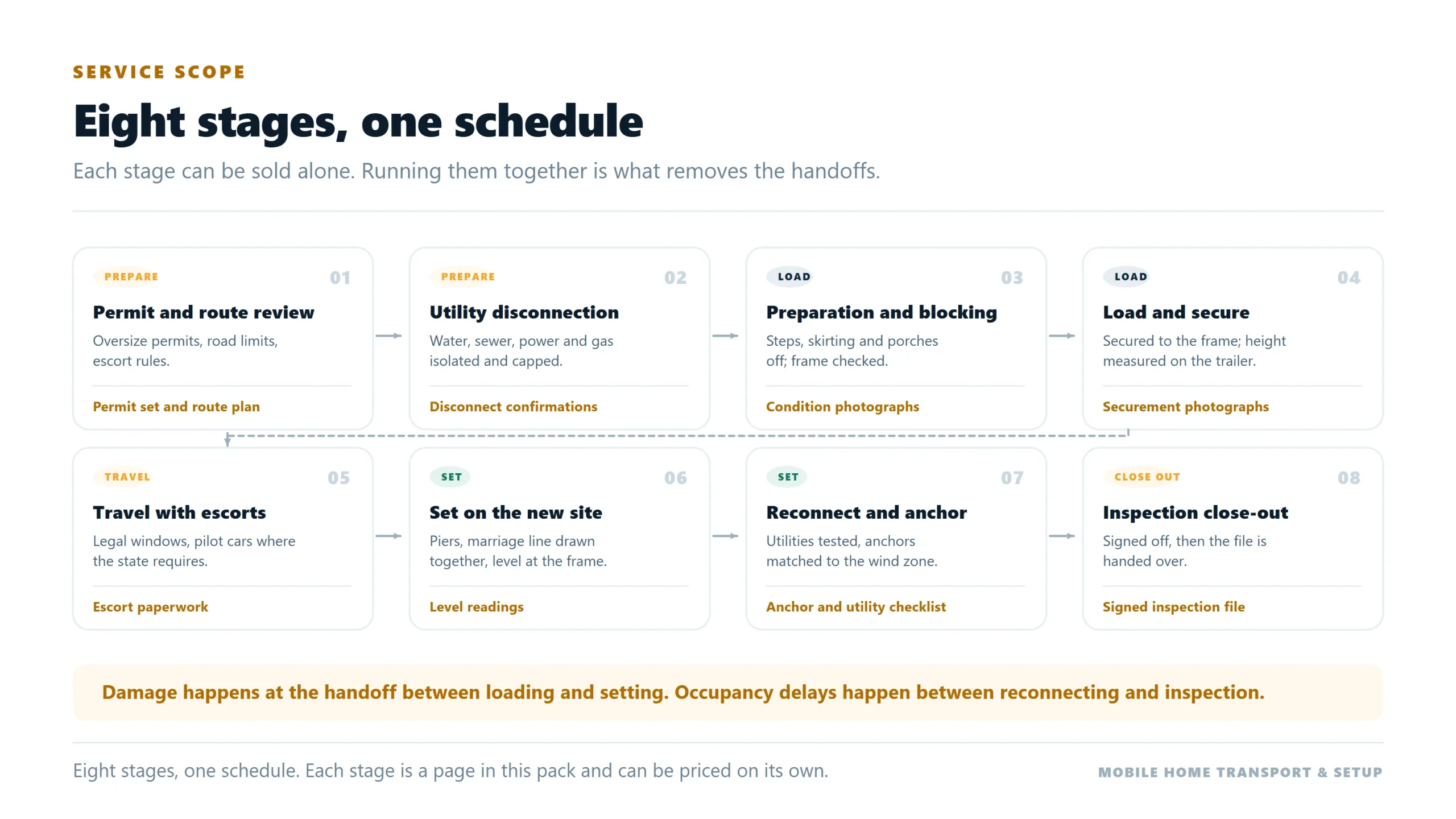
A complete job has eight stages: permit and route review, utility disconnection, preparation and blocking, load and secure, travel with escorts where the state requires them, set on the new site, reconnect and anchor, and inspection close-out. Each stage can be sold separately, and often is. The reason we run them together is that the handoff between loading and setting is where damage happens, and the handoff between reconnection and inspection is where occupancy gets delayed.
- Permits and route review. Oversize and overweight permits, county road restrictions, bridge clearances, escort rules and legal travel windows. The detail lives on our mobile home transport permits page.
- Disconnection and preparation. Water, sewer, power and gas isolated; steps, skirting and porches removed; the home blocked and the frame inspected before anything is lifted.
- Transport. Toter or truck and trailer, load secured to the frame, height measured on the trailer rather than estimated from a brochure. Covered in mobile home transportation.
- Set and level. Placement on the pad or piers, marriage line drawn together on a double-wide, then level readings taken at the frame, not the floor.
- Anchoring. Strap or anchor pattern matched to the wind zone, with the installation inspected before skirting closes it off.
- Utilities and close-out. Water, sewer and power tested under load, skirting and steps fitted, and a documentation file handed over for the lender, the insurer and the county.
Those eight stages are what the phrase mobile home transport services means in practice. A company that only owns a truck is selling stage four. A company that owns the whole sequence is selling a date you can plan around, and that difference shows up on the invoice in ways that are not always obvious at quote stage.
The services we run, and the problem each one solves
Our mobile home transport services are organised around the problems homeowners and site managers actually bring us, not around equipment. The table below is the short version; every row links to the page that covers it in depth. Each of these mobile home transport services is priced separately, so you can see exactly what you are buying.
| Service | The problem it solves | What is included |
|---|---|---|
| Mobile home transportation | The home has to leave one lot and arrive at another without structural damage | Route survey, permits, load, secure, travel, delivery inspection |
| Setup and installation | The home is on site but is not a home yet | Placement, marriage line, leveling, skirting, steps, utility rough-in |
| Leveling and stabilizing | Doors stick, floors slope, the home rocks when someone walks through it | Frame readings, pier correction, shimming, re-level after settlement |
| Anchoring and tie-downs | The installation has to survive the wind zone it sits in | Anchor pattern, strap tension, pier caps, inspection before skirting |
| Commercial installation | Dealers, parks and developers need units set on a schedule, not one at a time | Phased sequencing, per-unit pricing, utility coordination, close-out files |
| Relocation services | A whole household move, including the home, has to land on one date | Move planning, disconnection, transport, set, reconnect, debris removal |
| Repairs and maintenance | The move exposed a soft floor, a rotten rim joist or a failed connection | Subfloor, siding, trim, plumbing and skirting repairs after delivery |
| Inspection and code compliance | The county will not sign off, or the lender wants a report | Pre-inspection walk, correction list, re-inspection, documentation |
Two of those rows are worth reading before you call anyone. Transport and setup are the pair that most homeowners split between two companies to save money, and they are also the pair where a bad handoff costs the most. When the crew that sets the home is not the crew that loaded it, nobody owns a cracked marriage line or a bent frame ear. It is the most common way mobile home transport services go wrong.
How a job is sequenced from first call to final walkthrough
The order below is the one we use on every job, single-wide or multi-unit. It exists because each step produces information the next step needs, and skipping ahead is how a delivery date gets burned. It is also the order in which we quote mobile home transport services, stage by stage.
Address-to-address review
Both addresses, the home’s dimensions, age and roof type, and photographs of the approach at each end. Most surprises are visible in a phone photo of the driveway: a low wire, a steep culvert, a gate narrower than the home.
Permit and route plan
Which state permits are needed, whether an escort is required, which bridges and intersections are on the route, and what travel window applies. Rural routes often need a county permit on top of the state one.
Site readiness check
At the destination: pad or pier condition, slope, drainage, utility stub locations, and whether the toter can turn and leave after the home is placed. A site that cannot be entered loaded is a site that gets re-graded first.
Disconnect and prepare
Utilities isolated, porch and steps removed, skirting taken down, wheels and axles checked if the home is being towed on its own frame.
Load, measure and secure
The home goes onto the trailer or toter, the load height is measured on the vehicle, and the route clearance is checked against that number, not against the manufacturer’s specification.
Travel and delivery inspection
Escorted where required, with a walk-around and photo set at delivery, before the truck leaves. That photo set is what settles any later disagreement about damage.
Set, level and anchor
Placement, marriage line, frame readings, pier adjustment, then the anchor pattern for the wind zone. Leveling before anchoring, never the other way round.
Reconnect, test and close out
Water, sewer and power connected and tested under load; skirting and steps fitted; the inspection file assembled and handed over.
That is the whole of it, and it is deliberately unglamorous. Mobile home transport services are a scheduling business with a construction trade bolted on the end. The companies that do it well are the ones that treat the schedule as the product.
What decides the price of mobile home transport services
Two quotes for the same home can differ by thousands and both be honest, because they are quoting different scopes. Mobile home transport services are priced against scope, so scope is what you are actually comparing. Before comparing numbers, check what is inside them. The five variables below account for most of the gap.
- Distance and route. Mileage matters less than what is on the route. A hundred miles of interstate is cheaper than forty miles of county road with two low bridges and a weight-restricted crossing.
- Home size and configuration. A single-wide is one load. A double-wide is two loads, two permits in some states, and a marriage line that has to be drawn, sealed and inspected on site.
- Access at both ends. Trees, wires, fences, driveways and turning space. If a crane or a larger toter is needed, or a utility has to be disconnected and reconnected, that is real cost.
- Site work. Pads, piers, footings, grading and drainage. A home set on prepared piers is a different job from a home set on a site that has never held one.
- Compliance and paperwork. Permits, escorts, inspections and the documentation package. Cheap quotes usually exclude the inspection close-out, which is the part that decides whether you can occupy.
Our own pricing follows the same logic, which is why we ask for photographs and both addresses before giving a number. A quote built on a description is a guess with a signature line. For a line-by-line breakdown of what each element typically costs, the article on what it really costs to move a mobile home is the honest version.
Single-wide, double-wide and multi-unit: three different jobs
The scope of mobile home transport services changes with the home, and it does not change in a straight line. Two homes of similar length can be a one-day job and a three-day job, depending on how many loads they become.
Single-wide
One load, one permit in most states, and the shortest schedule. The complications are almost always at the ends: a tight driveway, a low service drop, or a destination pad that was never compacted. A single-wide move is a day’s work when the access is clean and a two-day job when it is not.
Double-wide
Two halves, two loads, and a marriage line that has to be drawn together, gasketed, sealed and checked before the home is closed up. The halves must be leveled as a pair, because leveling one side against the other is how a ridge beam ends up with a permanent gap. Double-wides also attract more permit scrutiny for width and height, and often need an escort. This is the job where mobile home transport services earn their price, because the second half is where the schedule and the seal both fail if the crew is guessing.
Multi-unit and commercial
A park infill programme, a dealer lot, or workforce housing is not twenty separate moves. It is one schedule with dependencies: pads before homes, utilities before skirting, inspection before the next phase. Our commercial mobile home installation page covers sequencing, per-unit pricing and close-out documentation for that work.
Permits, escorts and inspections: the compliance layer
Compliance is the part of mobile home transport services that homeowners underestimate and parks cannot afford to. Three separate authorities can be involved in a single move: the state DOT for the oversize load, the county or city for the road and the set, and the local building department for the installation and the utility connections. Each has its own form, fee and timeline.
The federal side is stable. Manufactured homes are built to the HUD manufactured housing construction and safety standards, and the data plate inside the home records the wind zone it was designed for. That plate decides the anchor pattern, and the anchor pattern decides whether the installation passes. Oversize movement on the highway sits under FMCSA and state permit rules, which is where escort and travel-window requirements come from.
What varies is local. Some counties want a foundation inspection before skirting goes on. Some want the utility trench inspected before it is backfilled. Some require a licensed installer to sign the set. We build the inspection order into the schedule rather than discovering it at the end, and the installation requirements hub collects the rules that come up most often.
The one document that saves the most time: a dated photo set of the home at delivery, plus the permit number and the inspector’s sign-off, kept in one folder. It is the difference between mobile home transport services that close cleanly and a file rebuilt from memory years later. Lenders, insurers and buyers ask for exactly those three things.
Where we provide mobile home transport services
We run mobile home transport services across our home state and into neighbouring states along established routes. Coverage is decided by route viability, not by a radius on a map: if the corridors work and the permits are obtainable, the job is doable. The mobile home movers near me page lists the counties and corridors we cover, and the service areas section explains how state pages are built when a route is new to us.
If you are outside the listed area, still ask. A move that starts or ends near a corridor we already run is often cheaper than the map suggests, and we would rather say no early than stretch mobile home transport services beyond what the route allows.
Questions homeowners ask about mobile home transport services
How far in advance should I book?
Two to four weeks for a straightforward single-wide, six to eight weeks for a double-wide or anything needing a crane. Permits are the usual bottleneck, not truck availability, and mobile home transport services book out fastest from March through June.
Do you move homes with the roof on?
Yes, when the measured load height clears the route. That is a measurement, not a preference, and the article on moving a mobile home with the roof on explains how the decision is made.
Is the home insured while it is on the truck?
Cargo and transit cover should be in place for the move itself, and your homeowner policy usually needs to be told the home is being relocated. Ask for the certificate before loading day rather than after, and check whether the destination site is covered during the set.
Who handles the utilities?
We disconnect and reconnect where licensing allows, and coordinate the utility company where it does not. Power and water are usually the longest lead items at the destination, so they get booked first. Utilities are also the part of mobile home transport services that most often decides the start date.
Can you set the home on land I already own?
Yes, provided the site is ready: pad or piers in, access clear, and the permit path identified. The guide to moving a mobile home to land sets out the order of work, and the setup checklist is the list we work through on the day.
Do you provide mobile home transport services for dealers and parks?
Yes. Dealer lot deliveries, park infill and unit turns are scheduled as phased work rather than one-off moves, because the units share permits, access and inspection windows. Mobile home transport services for a community are quoted per unit with the sequence agreed in advance.
What if the home fails inspection?
It gets a correction list and a re-inspection date. Most failures are small and predictable: a missing vapor barrier, an anchor spacing that does not match the wind zone, a tie-down that was never tensioned. The inspection and code compliance page covers the common ones.
How to compare mobile home transport services quotes
Ask every company the same six questions and the differences become obvious in about ten minutes. They are the questions that separate mobile home transport services from a truck and a phone number.
- Is the permit fee included, or estimated? Estimates that turn into invoices are the most common complaint in this trade.
- Who measures the load height, and when? The answer should be “on the trailer, before travel”.
- Is the set included? Transport and installation are separate scopes. A quote that only moves the home leaves you hiring a second crew.
- What is the inspection close-out? If nobody owns it, you own it.
- What happens if the schedule slips? Weather and permits move dates. Ask what notice you get and whether the price holds.
- Who is on site? A named crew, or a broker who subcontracts? Both exist in this market, and only one of them can answer a question about your home.
The mobile home moving FAQ collects the rest of the questions we get, and the page about our company explains how we are licensed, insured and staffed.
Book mobile home transport services
Send both addresses, the home’s make, model and dimensions, a photograph of each approach, and your target date. That is enough to price the job properly and to tell you which permits and inspections will be involved. Most quotes come back the same working day. Mobile home transport services quoted without both addresses and photographs are guesses.
If the move is still at the planning stage, start with the setup checklist and the cost breakdown, then request a quote when the dates firm up. Mobile home transport services are easier to buy when you know the sequence, and harder to compare when you do not.