


Mobile home leveling is the difference between a house that feels solid and one that tells you something is wrong every time a door sticks. Homes do not settle evenly: frost movement, poor drainage, undersized piers and a heavy addition on one end all shift the frame at different rates. Re-leveling corrects the geometry at the piers, where the load actually sits.
Table of Contents
This page explains how mobile home leveling is measured, what causes a home to move, what a correction involves, and when leveling will not solve the problem. It is written for owners who have noticed a door that will not latch and want to know whether they are looking at a $500 adjustment or a foundation issue.
Signs your home is out of level
- Interior doors that swing open or catch on the frame in the same spot every year.
- Cracks at the marriage line, or gaps that open and close with the seasons.
- A floor that feels springy or humps in the middle of a room.
- Water pooling against the skirting after rain, or soil pulling away from the perimeter.
- Windows that crack at the corners or no longer latch.
- Visible gaps between the skirting and the ground, or skirting buckling.
- A marble test: a marble placed on the floor rolls consistently toward one wall.
One or two of these can be cosmetic. Several together, or a slope you can feel walking across a room, means the frame needs measuring.
How we level a mobile home
- Survey. Laser level and a water level across the full footprint, plus pier-by-pier inspection for crushed blocks, rot, corrosion and missing caps.
- Diagnosis. Is it settlement, frost heave, water undermining the footings, an overloaded pier, or a frame that was never straight? Each has a different fix, and re-leveling without fixing the cause repeats the problem next season.
- Correction. Load transferred with jacks at the frame, piers rebuilt or re-shimmed to spec, wedges replaced with proper blocking rather than stacked shims.
- Stabilisation. Frame ties checked, anchor tension verified, and any pier that moved re-anchored so the correction holds.
- Drainage. Grading corrected so water runs away from the home, because water is the most common reason a home goes out of level again.
- Verification. Readings taken after correction and recorded, so the next owner or inspector can see the before and after.
Leveling versus stabilising — and why both matter
Leveling puts the home back on plane. Stabilising keeps it there: correct pier spacing, proper caps, frame ties, anchor tension, and a foundation that does not move with moisture. A crew that only jacks and shims will make the floor flat and leave the cause in place.
If the home is in a high-wind zone, stabilisation also means the anchoring system is checked at the same time. See anchoring and tie-downs.
What re-leveling costs
| Scenario | Typical range | What it involves |
|---|---|---|
| Single-wide, minor adjustment | $400–$900 | Survey, a handful of piers, shim correction |
| Single-wide, full re-level | $900–$2,000 | Multiple piers rebuilt, frame ties checked, drainage correction |
| Double-wide, full re-level | $1,500–$3,500 | Two sections, marriage line checked, more piers |
| With pier replacement or pad work | Add $300–$1,500+ | New footings, concrete pads, excavation |
Ranges reflect scope and access, not a fixed price list. A home on a tight lot with a deck that has to come off costs more than the same home with clear access.
When leveling will not fix it
If the frame is bent, corroded through, or the home has been overloaded by an unpermitted addition, jacking it level only hides the problem. In those cases we recommend structural repair or, in the worst case, that the home not be moved or re-sold as sound. We will show you the measurement and the photograph rather than ask you to take our word for it.
Keeping a home level
- Keep water moving away from the home: gutters, downspouts and grading.
- Do not stack heavy storage against one wall or over one pier line.
- Check skirting vents each season; trapped moisture softens the ground under the piers.
- Have the level checked after the first full freeze-thaw cycle in a new location.
- Fix plumbing leaks under the home quickly — a slow leak undermines footings quietly.
What a mobile home leveling service should check
Leveling is a measurement job before it is a labour job. A proper mobile home leveling visit produces numbers, not assurances:
- Readings across the full footprint, front to back and side to side.
- The slope direction and the amount, in inches over the run.
- Pier-by-pier condition: caps, shims, rot, corrosion, footing.
- Frame condition at the bearing points.
- Drainage direction and any sign of water under the home.
- Anchor tension and strap condition, since movement loads them.
- Marriage-line condition on a multi-section home.
If a mobile home leveling quote arrives without a survey, it is a guess with a price attached.
What causes a mobile home to go out of level
| Cause | What you see | What fixes it |
|---|---|---|
| Water undermining footings | One end drops, soil pulls away, skirting gaps | Drainage correction plus pier rebuild |
| Frost heave | Seasonal movement, doors that free in spring | Deeper footings below the frost line |
| Undersized or missing footings | Piers sinking into soil | New footings under the affected piers |
| Failed piers or crushed blocks | Visible cracking, a low corner | Pier replacement |
| Overloaded addition | Slope toward the added room | Additional piers and, sometimes, structural review |
| Poor original installation | A slope present since day one | Full mobile home leveling from the frame |
Mobile home leveling versus re-leveling
Leveling is what happens during installation, before the home is anchored. Re-leveling is the correction afterwards, once the home has settled or moved. Both use the same measurements, but re-leveling usually includes a diagnosis, because a home that moved once will move again unless the cause is addressed.
Our mobile home leveling work on existing homes always starts with that diagnosis: is this settlement, water, frost, or an overloaded pier? The correction is different in each case, and the price is different too.
What mobile home leveling does not fix
It does not repair a bent frame, replace rotted floor framing, or stop a leak. It does not make an unpermitted addition compliant, and it will not fix a marriage line that has separated because the sections were never properly fastened. Those are separate scopes, and a company that promises leveling will solve them is selling you the wrong job.
What it does do is restore the geometry the home was built around, so doors close, floors stop springing, and the structure stops loading in directions it was never designed for. See anchoring and repairs for the work that sits alongside it.
Mobile home leveling is diagnostic work, not brute force. The measurement tells you what moved; the inspection tells you why; the correction keeps it from moving again. If a contractor quotes mobile home leveling without surveying the home first, you are buying labour rather than a result. Ask for the readings before and after — a professional will have them, and they are the only proof that the work achieved anything.
Quick answers about mobile home leveling
- How do I know it is needed? Doors that stick, cracks at the marriage line and a floor that springs are the usual signals that mobile home leveling is overdue.
- How long does it last? A mobile home leveling correction holds for years if the drainage and footings are right, and weeks if they are not.
Frequently asked questions
How often should a mobile home be re-leveled?
Most homes need a check every three to five years, and sooner after a move, a hard freeze, or a summer of drought followed by heavy rain. New installations should be checked after the first seasonal cycle.
Can I level a mobile home myself?
Jacking a manufactured home is dangerous and, in many jurisdictions, regulated work. The frame can twist, the home can slip off a jack, and an improper pier can fail under load. This is not a homeowner DIY job.
Will leveling fix cracks at the marriage line?
Often it reduces them, but cracks at the join usually mean the seal has failed as well. The joint should be re-sealed after leveling, and the cause — movement or water — corrected.
Does leveling help with a sticking door?
Usually. A door that sticks in one season and frees in another is a classic level or moisture signal rather than a door problem.
How level is level? The tolerance that actually matters
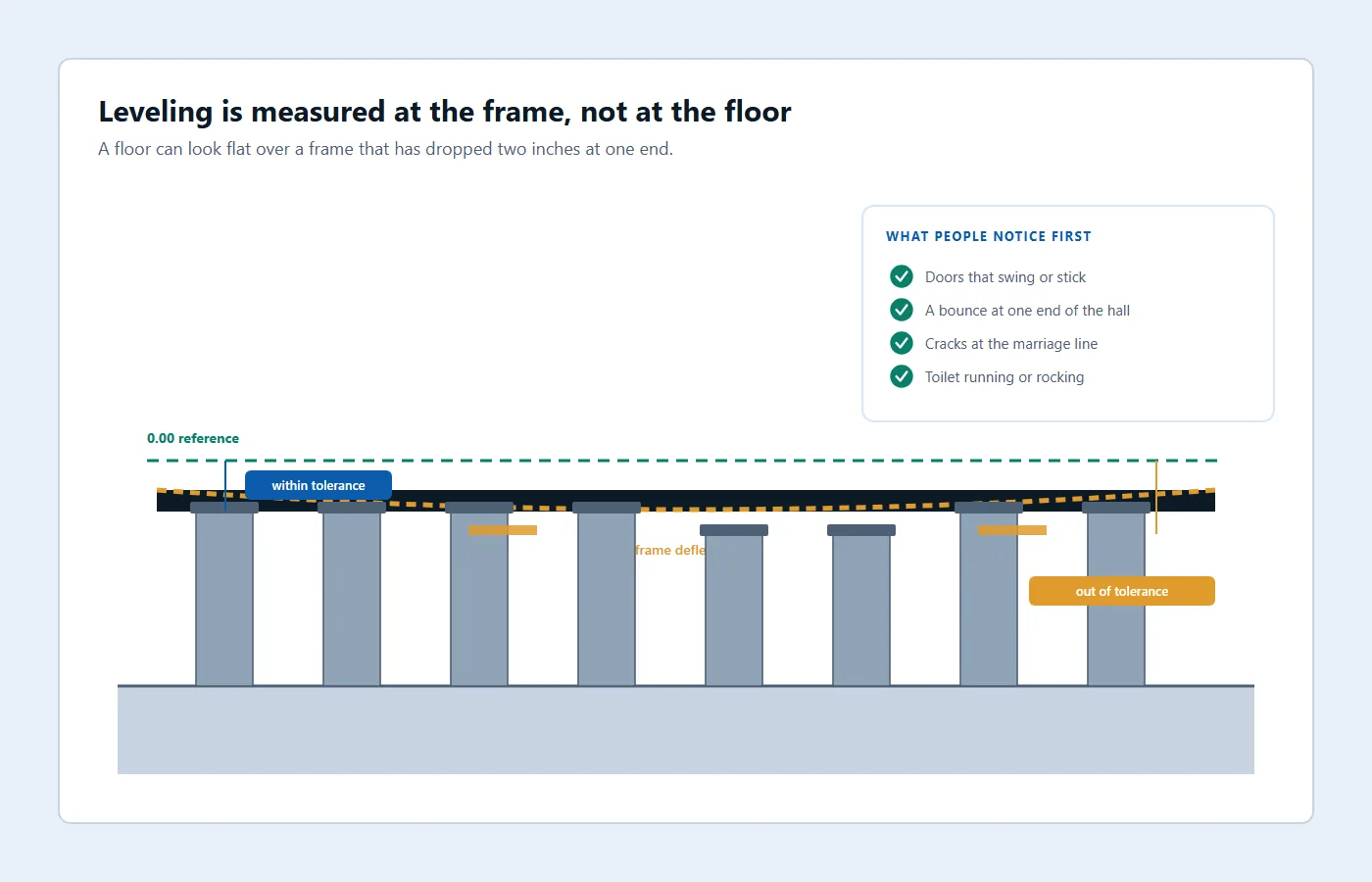
“Level” is not a binary. Every home moves, every frame deflects under load, and every floor has a slope somewhere. What matters is whether the frame sits within the tolerance the manufacturer and the local code allow, measured across the length and the width of the home, and whether the piers are all carrying load rather than some hanging in air.
In practice, a crew works to a small tolerance across the full frame — measured in fractions of an inch over the length of the home, not in degrees on a spirit level laid on a countertop. A floor can read flat while the frame behind it has dropped at one end, which is why the measurement is taken at the steel, and why a laser reference is used rather than a level laid on the carpet.
The three measurements we take
- Longitudinal. From one end of the frame to the other, at several points, to find the overall fall.
- Transverse. Across the width at each pier line, to find a twist rather than a slope.
- Pier load. Whether each pier is in contact and carrying its share. A pier with a gap is a pier doing nothing, and the load it should carry is sitting on its neighbours.
Why homes go out of level, in order of how often we see it
| Cause | How it shows up | What fixes it |
|---|---|---|
| Soil settlement under the piers | One end or one corner drops over months, doors begin to bind | Re-level, plus a footing correction if the soil is the problem, not just the shim |
| Water | Soft ground at a downspout, a low corner or a slope that drains under the home | Drainage first, then leveling. Leveling without drainage is a subscription |
| Frost heave | Seasonal movement in cold climates, worst in spring | Footings below frost depth, or a foundation designed for the climate |
| Organic material or fill under the home | Progressive, uneven, worsens every wet season | Removal or an engineered foundation, not more shims |
| Overloading | A heavy addition, a hot tub, a loaded storage room at one end | Load redistribution and additional piers, then level |
| Failed or missing piers | A gap under the frame, a cracked block, a rusted stand | Replace the pier, re-establish load, then level the frame |
If two homes on the same street have the same problem at the same time, the cause is almost always the ground or the water, not the installer. That is why a re-level quote that does not mention drainage is a quote for a repeat visit.
Re-leveling: what the job involves and how long it takes
A re-level is not a matter of jacking a corner and walking away. The home has to be lifted off the piers that are carrying too much, the piers adjusted or replaced, the frame brought back to a single reference plane, and the load redistributed so every pier is working. Then the home has to be re-anchored, because lifting a frame disturbs the tie-downs, and the skirting has to come off and go back on.
The sequence
Survey and moisture check
Measure the frame, find the low points, check the ground and the drainage, and confirm the piers are the problem rather than the frame.
Expose the perimeter
Skirting removed far enough to reach the piers. Insulation and vapor barrier moved aside and protected.
Lift in stages
Hydraulic jacks at the frame, lifted evenly and slowly. A home lifted at one point cracks at another.
Correct the piers
Shim, cap, replace or add piers. Footings corrected where the ground has failed.
Set the reference and level
Laser reference established, frame brought to it, checked longitudinally and transversely, checked again after load.
Re-anchor and close up
Tie-downs re-tensioned to the wind zone pattern, vapor barrier restored, skirting refitted with ventilation intact.
A straightforward single-wide re-level is usually a day. A double-wide with pier replacement, or a home that needs drainage work first, runs two to three days plus drying time. Anything involving an engineered foundation is a different job with a different price.
Signs you can check yourself in ten minutes
- Doors. Open every interior door halfway. A door that swings on its own is telling you the frame is out of level in that direction.
- Floors. Walk the perimeter of each room. A slope you can feel with a bare foot is worth measuring.
- Cracks. Hairline cracks at the marriage line, at interior corners, or around window openings.
- Windows. A window that will not latch, or a gap that appears at one corner of the frame.
- Water. Standing water, a damp crawlspace, or a downspout that discharges against the skirting.
- The skirt line. A skirt panel that has dropped or buckled usually means the home above it has moved.
Cheap test: put a marble on the floor at the centre of the longest wall and watch where it goes. It will not tell you the tolerance, but it will tell you the direction, and that is enough to ask the right question.
Once the frame is right, most of the symptoms stop. What does not stop is the cause, if the cause was water. Fixing the level without fixing the drainage is the single most common reason homeowners call a second company eighteen months after the first one was paid.
How often a home actually needs re-leveling
There is no service interval printed in a manual, because leveling is not maintenance in the scheduled sense. A home that was set correctly on ground that drains stays level for years. A home on clay that holds water, or on a pad that was never compacted, will move within a couple of seasons.
| Condition | Likely interval | What drives it |
|---|---|---|
| Correct set, graded site, good drainage | Rarely, or never | Nothing much moves |
| Expansive clay, poor drainage | Every 2–4 years | Wet and dry cycles |
| Frost-susceptible ground, shallow footings | Seasonal movement | Freeze and thaw |
| Home with a heavy addition | Once, after settlement | Load redistribution onto new piers |
| Recent re-level | Re-check at 6–12 months | Load finding its level |
If a company tells you a home needs leveling every year as routine maintenance, ask them what they measured. A level reading in the first season after a set is a legitimate follow-up; an annual invoice for the same adjustment is a sign the cause was never addressed.
Level also matters at two moments beyond comfort: inspection, where the reading is a pass or fail, and resale, where a surveyor will note a frame that is out of tolerance. The inspection page explains what the county measures, and the federal installation standard behind the tolerance is published in 24 CFR Part 3285.
Mobile home leveling: the questions that decide the job
Mobile home leveling is measured, not judged by eye, and the answers below explain what that means in practice. If a company cannot tell you how it will measure, the work is guesswork.
How do I know my home needs mobile home leveling?
Doors that swing on their own, a floor that slopes underfoot, cracks at the marriage line and windows that will not latch. A level reading confirms it.
How long does mobile home leveling take?
A single-wide re-level is usually a day. Pier replacement, drainage work or a double-wide with a stubborn marriage line can run two to three days.
Is mobile home leveling covered by warranty?
Workmanship cover on a recent set usually applies if the home has moved within the warranty period. Ground movement is the exception most warranties exclude.
Can mobile home leveling fix a soft floor?
Only where the cause is a low pier under that area. A soft floor is usually water damage, and mobile home leveling does not repair rot.
Does mobile home leveling require re-anchoring?
Yes. Lifting a frame disturbs the tie-downs, so the anchors are re-tensioned and often re-checked against the zone requirement.
Will mobile home leveling stop doors from sticking permanently?
If the frame is the cause, yes. If a door was trimmed to fit an out-of-level opening, the trim becomes the next problem to correct.
How soon after mobile home leveling should I check again?
Six to twelve months, once the load has settled onto the piers. A reading then tells you whether the ground is stable or still moving.
Mobile home leveling in short
- Mobile home leveling is measured at the frame, longitudinally and transversely.
- A door that swings on its own is a mobile home leveling symptom.
- Mobile home leveling fixes the cause only when the piers are the cause.
- Water is the usual reason mobile home leveling is needed twice.
- Mobile home leveling requires re-tensioning anchors afterwards.
- Pier replacement often comes with mobile home leveling on clay ground.
- Mobile home leveling readings belong in the handover file.
- Mobile home leveling should be re-checked within a year.
- An engineered foundation is a different scope from mobile home leveling.