


Mobile home inspection answers one question before money moves: is this home sound, legally identifiable, and able to travel and be installed? Most buyers inspect the kitchen and the roof. The expensive problems live underneath — in the frame, the piers, the vapour barrier and the paperwork.
Table of Contents
Below is what we check, what the findings mean, and how to tell a stop item from a negotiating point. A mobile home inspection is worth doing before you buy, before you move, and before an inspector arrives with a clipboard and a checklist of their own.
We inspect for buyers, sellers, park managers and lenders, and we inspect our own installs before the code officer arrives.
What a pre-purchase inspection covers
| System | What we check | Why it matters |
|---|---|---|
| HUD label and data plate | Exterior certification label, interior data plate, serial and VIN match | Missing tags complicate title, lending, insurance and some moves |
| Frame and chassis | Corrosion, bends, welds, outriggers, hitch points | A compromised frame can make the home unmovable |
| Foundation and piers | Pier condition, caps, spacing, footings, shimming, level readings | Settlement and failed piers are the most common structural defect |
| Anchoring | Anchor type, strap angle, spacing, corrosion, wind-zone match | Insurance and inspection both hinge on it |
| Belly and moisture | Vapour barrier, insulation, standing water, plumbing leaks, rot at the rim joist | Hidden moisture destroys floors from below |
| Marriage line | Alignment, fasteners, seal condition, roof join | The classic leak and crack location on double-wides |
| Roof and ceilings | Membrane or shingle condition, ponding, ceiling stains, vent seals | Water entry is the top cause of interior decay |
| Electrical | Panel, bonding, GFCI protection, visible wiring defects | Fire risk and an insurability issue |
| Plumbing and HVAC | Supply and drain condition, water heater, furnace, ductwork | Repair costs that rarely appear in a listing |
| Additions | Permits for porches, rooms, carports, decks | Unpermitted work becomes your liability and blocks some moves |
Inspection during and after installation
A code inspection is a different exercise from a pre-purchase inspection. The code officer checks compliance with the permitted scope: piers and blocking, level, anchoring to the wind-zone pattern, utility connections and, where required, the installer’s certification. Our own pre-inspection happens before that visit so defects are corrected without a failed inspection on record.
What typically fails a first inspection:
- Anchor straps outside the 30–60 degree range, or too few vertical ties for the zone.
- Piers without caps, or shims stacked beyond spec.
- Missing or damaged vapour barrier under the home.
- Skirting installed with no ventilation.
- Utility connections without the required bonding, disconnects or support.
- Paperwork gaps — the certification filing or the permit not on site.
Compliance issues that follow the home, not the owner
Two things travel with a manufactured home and cause trouble years later: the wind zone it was built for and the record of how it was installed. A Zone I home placed in a Zone III area is a code and insurance problem even if it has stood for a decade. An installation with no documentation is hard to prove compliant at resale.
We check both during inspection and record what we find. The regulation detail sits on our installation requirements guide, and the anchoring specifics on the tie-down page.
What an inspection costs
| Scope | Typical range |
|---|---|
| Pre-purchase, single-wide | $300–$600 |
| Pre-purchase, double-wide | $450–$900 |
| Pre-move fitness inspection | $250–$600 |
| Post-installation compliance check | $250–$500 |
| Report with photo log and repair estimate | Included, or small add-on |
Distance and travel time affect the number. A written report with photographs is standard, because a verbal “looks fine” is worthless in a negotiation.
Reading the report
We separate findings into three buckets so you can act:
- Stop items. Frame, structural, tag or safety defects that should end the purchase or the move.
- Negotiate items. Repairs with a known cost that belong in the price conversation.
- Watch items. Maintenance that is not urgent but will become expensive if ignored.
If you are buying, pair the inspection with our relocation service so the move, permits and installation are sequenced around the findings.
What a mobile home inspection report should contain
A report you can act on has five parts: the identification (HUD label, data plate, VIN), the condition findings by system, photographs keyed to each finding, a repair estimate with ranges, and a clear recommendation. Anything less is a walkthrough with a signature.
Our mobile home inspection reports separate findings into stop, negotiate and watch items, because that is how a buyer actually uses them.
Mobile home inspection findings that change a purchase
| Finding | Why it changes the deal |
|---|---|
| Corroded or bent frame | The home may not be legally or safely movable; transport quotes become irrelevant |
| Missing HUD label or data plate | Title, lending and insurance complications that can take months to resolve |
| Widespread floor rot | Repair cost against home value; often a walk-away on older units |
| Anchoring mismatched to the wind zone | Inspection failure, insurance problem, and a re-anchor cost |
| Unpermitted additions | Liability transfers to you, and some jurisdictions require removal before a move |
| Active water intrusion | The cause must be found, not painted over; mould and framing damage follow |
Mobile home inspection before a move versus before a purchase
The two overlap but are not identical. A pre-purchase mobile home inspection weighs repair cost against value. A pre-move inspection asks a narrower question: will this home survive the road, and will it pass installation at the destination? Frame condition, roof height and HUD documentation matter more in the second case; cosmetics matter less in both.
If you are doing both, do them in one visit. It costs less and produces one consistent record.
Mobile home inspection and code compliance at installation
Code compliance is checked against the permit scope: piers and blocking as specified, level readings, anchoring to the wind zone, utility connections and the certification filing. A mobile home inspection before that visit finds the failures while they are still cheap to correct — a strap angle, a missing cap, an unvented skirt panel.
Where a first inspection fails, the correction and re-inspection are usually the installer’s cost, not yours. That is worth confirming in writing before work starts. See our setup page for the sequence, and the compliance guide for the standards.
The value of a mobile home inspection is not the report — it is the decision it lets you make. Walk away, renegotiate, or proceed with a known repair budget. What you cannot do is un-know a corroded frame after the truck is loaded. If you are buying at a distance, have the mobile home inspection done before the deposit, and read the photographs rather than the summary.
Quick answers about mobile home inspection
- When should it happen? Before you pay a deposit, and again before the haul if the mobile home inspection was done months earlier.
- What does it cost? Roughly $300–$900 depending on size, and a mobile home inspection includes photographs and a written report.
Frequently asked questions
Do I need an inspection to buy a used mobile home?
Not legally in most places, but skipping it is how buyers inherit a frame that cannot be moved or a home that fails its installation inspection. The cost is small against the risk.
Can you inspect a home in another state?
Within our coverage, yes, and we coordinate remotely for out-of-area purchases where we cannot travel — usually by working with a local inspector and reviewing the report with you.
Does an inspection guarantee the home?
No. It is a visual and measurement-based assessment of accessible systems at the time of inspection. It does not open walls, test every circuit, or predict future failure.
Will an inspection report help with insurance?
Often. Documented anchoring, a sound frame and a compliant installation are exactly what carriers ask about for manufactured homes.
What the inspector is looking for, category by category
An installation inspection is not a general opinion about the home. It is a check against a specific standard, applied to specific items, and it either produces a signature or a list of corrections. Knowing the categories tells you what to have ready and what to photograph before the inspector arrives.
| Category | What is checked | What fails it |
|---|---|---|
| Identity | HUD label, data plate, serial number, title match | A missing label, a plate that does not match the title, a home moved without documentation |
| Foundation | Pier spacing, footings, caps, shims, frame contact | Block on bare soil, missing caps, piers not carrying load |
| Level | Frame within tolerance across length and width | Visible fall, doors binding, a frame shimmed rather than leveled |
| Anchoring | Anchor type, spacing, strap angle, frame connection, wind zone match | Vertical-only straps, straps on the wrong member, wrong spacing |
| Marriage line | Bolted to pattern, sealed, no daylight | Missing bolts, sealant over debris, an open seam |
| Enclosure | Vapor barrier, skirting, ventilation, access hatch | Bare soil, sealed skirting, no access |
| Utilities | Water, sewer, electric, gas connected and tested | Unlicensed work, untested connections, no shut-offs labelled |
| Egress and safety | Steps, landings, handrails, smoke and CO alarms | Missing handrail, steps without a landing, no alarms |
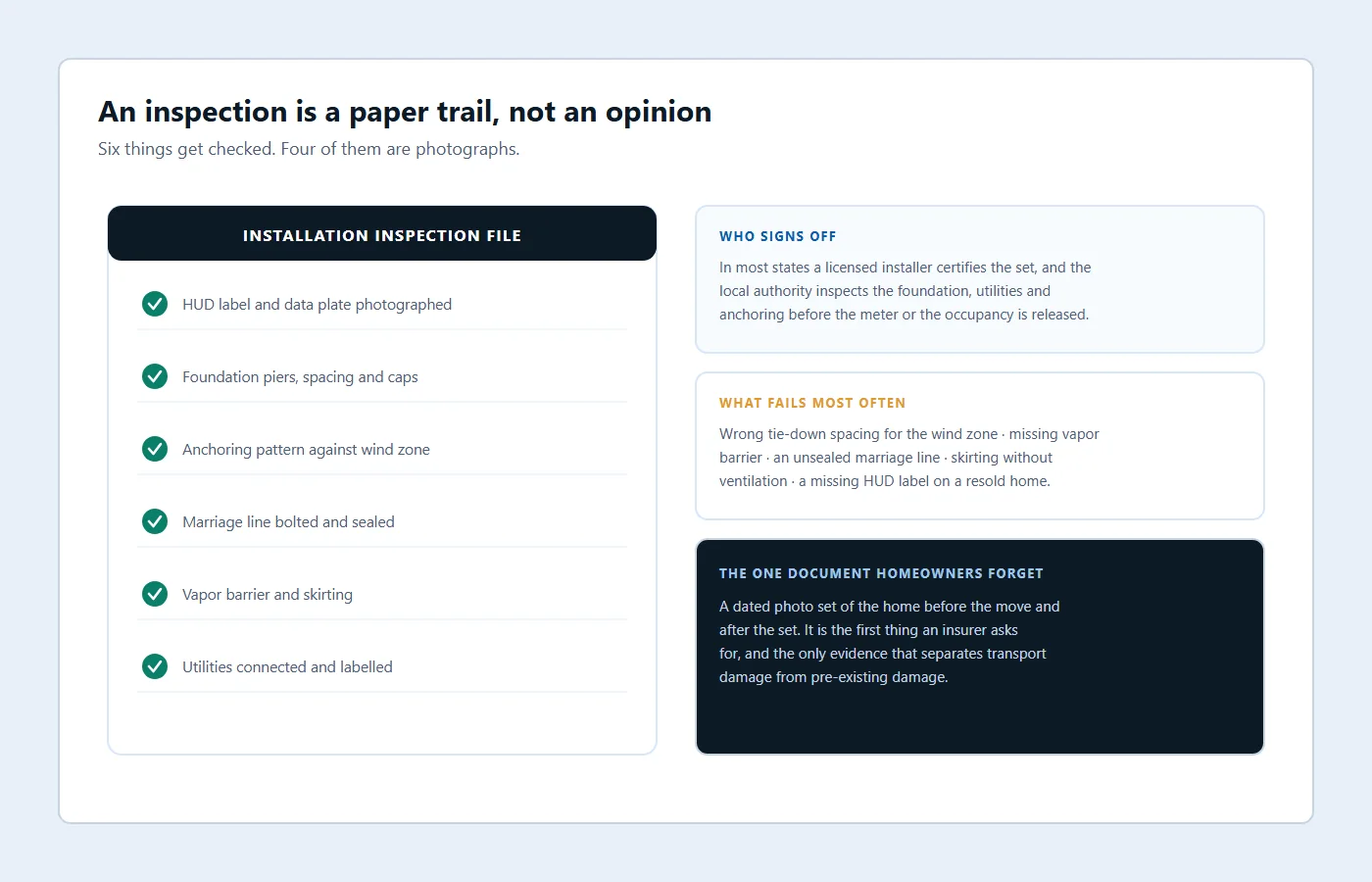
The documents that make an inspection go smoothly
- The permit. Issued, posted where the jurisdiction requires it, and matching the address.
- The installation certification. Signed by the licensed installer, naming the standard and the wind zone.
- Photographs. Piers, anchors, frame connections and the marriage line, taken before the skirting closed them in.
- Level readings. The measurements taken at handover, with a date.
- Utility test records. Who connected what, when, and under which licence.
- The manufacturer’s installation manual. The inspector may ask for the page that governs your model’s pier spacing.
The ten-minute version: if you can produce those six documents and open the access hatch, the inspection is usually a short visit. If any one of them is missing, the inspector has to establish the fact by inspection instead of by record, and that is when appointments multiply.
Pre-purchase inspection versus post-installation inspection
These are different jobs with different purposes, and confusing them is expensive.
Pre-purchase inspection
- Is the home worth buying?
- Condition of roof, subfloor, plumbing, electrical, HVAC
- Evidence of water damage, repairs, past movement
- HUD label and title status
- Whether it can be moved at all — and at what cost
- Performed before money changes hands
Post-installation inspection
- Was the installation done to the standard?
- Foundation, level, anchoring, marriage line
- Utilities connected and tested
- Egress, steps, alarms
- Produces a signature or a correction list
- Performed before occupancy and before final payment
A pre-purchase inspection that does not consider transport is half a job. The single most expensive surprise in this market is a cheap home that cannot be moved legally or economically — a 14-foot-wide section with a roof that will not clear the route, or a home whose title has a lien nobody mentioned.
Compliance problems that follow the home rather than the owner
Some defects attach to the structure and travel with it. A missing HUD label is the clearest example: the label is the home’s federal identity, and a home without one can be difficult to sell, difficult to insure and, in some jurisdictions, difficult to permit. Replacing a lost label is possible but it is an application to HUD, not a trip to a hardware store, and it takes time.
Other issues that follow the home:
- An altered structure — a removed wall, a modified roof, an addition that was never engineered. It may be fine, but it has to be documented.
- A data plate that does not match the title — usually a paperwork problem, occasionally a serious one.
- An installation that was never inspected — common on private land in rural counties, and increasingly a problem at resale or refinance.
- Unpermitted utility work — the next owner inherits it, and so does their insurer.
If you are buying, ask for the installation record and the HUD documentation before you sign. If you are selling, produce them. If they do not exist, an inspection now is cheaper than a buyer’s inspection later.
What an inspection costs, and what it saves
An installation inspection is a modest line compared with the rest of a move, and the cost is mostly the inspector’s time plus travel to a rural site. What it saves is not abstract: an unanchored or badly founded home is a repair bill measured in thousands, an insurance dispute, and in some cases an occupancy refusal.
Where the money actually goes when an inspection fails:
| Failure | Typical correction | Relative cost |
|---|---|---|
| Wrong anchor spacing | Add anchors, re-tension, re-photograph | Low to moderate |
| Piers without footings | Expose, pour or set pads, re-level | Moderate |
| Marriage line not sealed | Open, clean, re-seal, re-check | Low |
| No vapor barrier | Install ground cover and ventilation | Low |
| Foundation not engineered where required | Redesign and rebuild the foundation | High |
| Home ineligible for the site’s wind zone | Cannot be corrected — the home does not belong there | Project-level |
The last row is the one to check before you buy the land. It is also the reason we ask for the county before we quote: the address decides the rules, and the rules decide whether the project is possible at all. The federal standards behind the checklist are published at 24 CFR Part 3285 and summarised by HUD’s Office of Manufactured Housing Programs.
A self-check you can run before the inspector arrives
Inspections fail on small things, and most of them are visible without any equipment. Walking the job the day before costs an hour and saves a re-inspection fee and a week of schedule.
- Skirting open. The underside has to be accessible. If the skirting is on, take a panel off at each corner so the inspector can see the piers and anchors.
- Piers visible and consistent. No missing shims, no cracked blocks, no pier sitting on soft ground or on spoil.
- Anchors and straps. Every anchor in the pattern, every strap tensioned, nothing rubbing through a frame edge.
- Vapour barrier intact. Patched at the piers, lapped, and not hanging loose at the perimeter.
- Marriage line. Gaskets in place, fasteners at the specified spacing, no gap visible from underneath or inside.
- Steps and rails. Fixed, stable, and bearing on a proper base rather than soil.
- Permit and plans on site. The inspector will want to see what was approved, not a description of it.
- Site clean. Offcuts, packaging and spoil removed. It is not a code item, but it is the first impression of the work.
If it fails: corrections, re-inspection and who pays
A failed inspection is not a catastrophe; it is a list. What matters is the process that follows it, and that process should be written into your agreement before the work starts.
- The correction is made by the installer, to the inspector’s item, not to an approximation of it.
- The re-inspection is booked and, in most jurisdictions, carries its own fee.
- The paperwork is re-issued with the corrected date, because the certification has to reflect the installation as it stands.
- You do not occupy the home until the sign-off exists, because the correction becomes your problem once you move in.
Ask, before you sign anything, who pays for the re-inspection if the first one fails. A company that answers “we do” is confident in its crew. A company that answers “you do” has told you how it expects the job to go. The inspection framework itself sits within the federal installation standard, summarised by HUD’s manufactured housing program, and applied locally by your building department. For what the documentation file should contain, see our setup and installation guide.
Mobile home inspection: what gets checked and what happens next
A mobile home inspection is a walk through the installation against the adopted code, and it produces a list rather than an opinion. Knowing what is on that list is the difference between passing and re-booking.
Who performs a mobile home inspection?
Usually the county or city building department. Some states use a licensed installer’s certification, and a few use a third-party agency on the jurisdiction’s behalf.
What does a mobile home inspection cover?
Support and piers, level readings, anchoring pattern and tension, the marriage line, the vapour barrier, skirting ventilation, utilities and the paperwork.
How long does a mobile home inspection take?
Under an hour on a straightforward home, provided the underside is accessible. Skirting left in place is the usual reason it cannot proceed.
What happens if a mobile home inspection fails?
The installer corrects the item, the re-inspection is booked and, in most places, a fee applies. Occupying the home before sign-off shifts that risk to you.
Can I be present at a mobile home inspection?
Yes, and you should be. It is the best opportunity to ask what the inspector is looking at and to record what was accepted.
Does a mobile home inspection certificate transfer on sale?
The record of the installation does, and it is what a buyer’s surveyor will ask for. Keep the file with the home’s documents.
Is a mobile home inspection the same as a home inspection?
No. A home inspection assesses condition for a buyer; a mobile home inspection confirms the installation meets the code.
Mobile home inspection in short
- Mobile home inspection checks support, level, anchoring and the envelope.
- The underside must be accessible for a mobile home inspection.
- A mobile home inspection produces a list, not an opinion.
- Re-inspection fees follow a failed mobile home inspection in most counties.
- Occupancy before mobile home inspection sign-off shifts risk to the owner.
- Mobile home inspection records belong with the home’s documents.
- A buyer’s survey is not a mobile home inspection.
- Photographs before a mobile home inspection speed up corrections.