


Mobile home repairs are mostly about stopping water and stopping movement. Rot at the rim joist, a soft subfloor by the bathroom, skirting that has been kicked in by a mower, a roof seam that drips into a ceiling panel — none of these are cosmetic, and all of them get more expensive when they wait a season.
Table of Contents
This page covers the failures we see most, how to tell a repair from a rebuild, what each job typically costs, and the maintenance that prevents both. Mobile home repairs are usually cheaper than the damage they prevent — the trick is catching them while they are still small.
We repair the building envelope, the floors and the access systems, and we tell you when a repair is not worth doing.
The repairs we handle most
| Problem | Typical cause | What the repair involves |
|---|---|---|
| Soft or spongy subfloor | Slow plumbing leak, failed seal at the toilet or tub, condensation | Cut out the damaged section, treat the joists, replace with moisture-resistant decking, re-seal |
| Rim joist and floor edge rot | Skirting trapping moisture, blocked vents, ground contact | Replace affected framing, correct ventilation, reinstate the vapour barrier |
| Skirting damage | Mower strikes, frost heave, storm debris | Panel replacement, re-fixing to the frame, restoring vented sections |
| Roof leaks | Failed sealant, lifted shingles, ponding, vent boots | Seam repair, flashing and boot replacement, partial re-cover |
| Ceiling stains and sag | Long-term water entry | Source repair first, then panel replacement; never paint over an active leak |
| Door and window problems | Frame movement, failed seals, swelling | Re-hang, re-frame, replace glazing or the unit |
| Marriage line separation | Movement, failed fasteners, water at the join | Re-align, re-fasten, re-seal; investigate level before closing it up |
| Storm damage | Wind, hail, fallen limbs | Make safe, document for insurance, then repair |
Repair or replace? The honest calculation
Three questions decide it:
- Is the structure still sound? Rot in a floor section is repairable. Rot through the frame or a wall’s load path is a different conversation.
- Is the cause fixed? Replacing a subfloor without finding the leak is a subscription, not a repair.
- What is the home worth after? A $4,000 repair on a home worth $25,000 may be right if it keeps the home insurable and habitable. The same repair on a home that cannot legally move may not be.
Maintenance that prevents the expensive repairs
- Twice a year: walk the perimeter, check skirting and vents, look for soil pulling away, and clear gutters.
- Twice a year: look under the home with a light for standing water, tears in the vapour barrier, or corroded straps.
- Annually: check roof seams, vent boots and flashing before the wet season.
- Annually: test GFCI outlets and check the water heater pan and relief line.
- After any storm: photograph everything before you clean up, for insurance.
- Every few years: have the level checked. Leveling service.
A maintenance plan is cheaper than a repair, and it protects resale value. Buyers and lenders ask for records, and a home with a folder of maintenance history sells faster than one with a story.
Costs
| Repair | Typical range |
|---|---|
| Subfloor section replacement | $400–$1,500 |
| Rim joist / floor edge repair | $600–$2,000 |
| Skirting replacement (single-wide) | $700–$2,000 |
| Roof seam and flashing repair | $350–$1,200 |
| Marriage line re-seal | $400–$1,000 |
| Storm damage make-safe | $300–$1,000 before insurance scope |
How to tell a repair from a rebuild
Three tests decide it, and they apply to almost every mobile home repairs job:
- Is the water source fixed? If not, the repair is temporary by definition.
- Is the structure around the damage sound? Replacing a floor section between rotten joists is wasted money.
- Does the repair preserve the home’s compliance? A repair that compromises the vapour barrier, the anchoring or the frame bearing is not a repair.
Mobile home repairs we recommend before a sale
Sellers ask us this constantly. The answer is not “fix everything” — it is fix what an inspector or a buyer’s lender will flag, and document the rest.
- Active leaks and the staining they caused.
- Soft floor sections in bathrooms and kitchens.
- Damaged skirting and missing vent panels.
- Anchoring that does not match the wind zone.
- Doors and windows that no longer latch.
- Any HUD label or data plate issue, resolved before listing.
Cosmetic work sells a home; structural work closes a sale. Our inspection service gives you the list in priority order.
Mobile home repairs after a storm
Photograph everything before you clean up, and do not discard damaged material until the adjuster has seen it. Make-safe work — tarping, boarding, securing loose skirting — is usually covered and should be documented separately from the permanent repair.
Storm work also exposes anchoring problems. If a strap bent or an anchor pulled, the mobile home repairs scope should include re-anchoring to the correct pattern, not just replacing the bent hardware.
Maintenance that prevents mobile home repairs
| Frequency | Task | Prevents |
|---|---|---|
| Spring and autumn | Walk the perimeter, check skirting and vents, clear gutters | Rim joist rot, water intrusion |
| Spring and autumn | Inspect under the home with a light | Vapour barrier tears, plumbing leaks |
| Annually | Check roof seams, boots and flashing | Ceiling stains and insulation damage |
| Annually | Test GFCIs, check the water heater pan | Electrical faults, hidden leaks |
| Every 3–5 years | Level check | Frame stress, marriage-line cracks |
Most mobile home repairs start as water or movement, and both get worse quietly. A soft floor by the bathroom, a stain on a ceiling panel, skirting that no longer meets the ground — each is a signal rather than a surface problem. Fix the cause, repair the damage, and keep the record. When you sell, that file is worth more than a fresh coat of paint.
Quick answers about mobile home repairs
- Repair or replace? If the frame and surrounding structure are sound, mobile home repairs are almost always the better value.
- Do you handle insurance work? Yes, with a documented scope and photographs for the adjuster on any storm-related mobile home repairs.
- What comes first? Stop the water. Every durable mobile home repairs job begins with finding the source, not covering the stain.
Frequently asked questions
Can a soft floor in a mobile home be repaired?
Usually yes. A section of subfloor can be cut out and replaced once the water source is fixed and the joists are assessed. Widespread rot through the frame is a bigger decision.
Do you work with insurance claims?
Yes. We document damage with photographs and a written scope you can submit, and we can work to the adjuster’s approved scope.
How do I stop skirting from trapping moisture?
Keep the vented panels clear, do not seal the skirting airtight, and make sure the ground inside slopes away from the home. Ventilation is the point of skirting, not decoration.
Do you repair homes you did not install?
Yes. We assess what is there and tell you what is worth fixing.
Diagnosing a soft floor: the five questions that find the cause
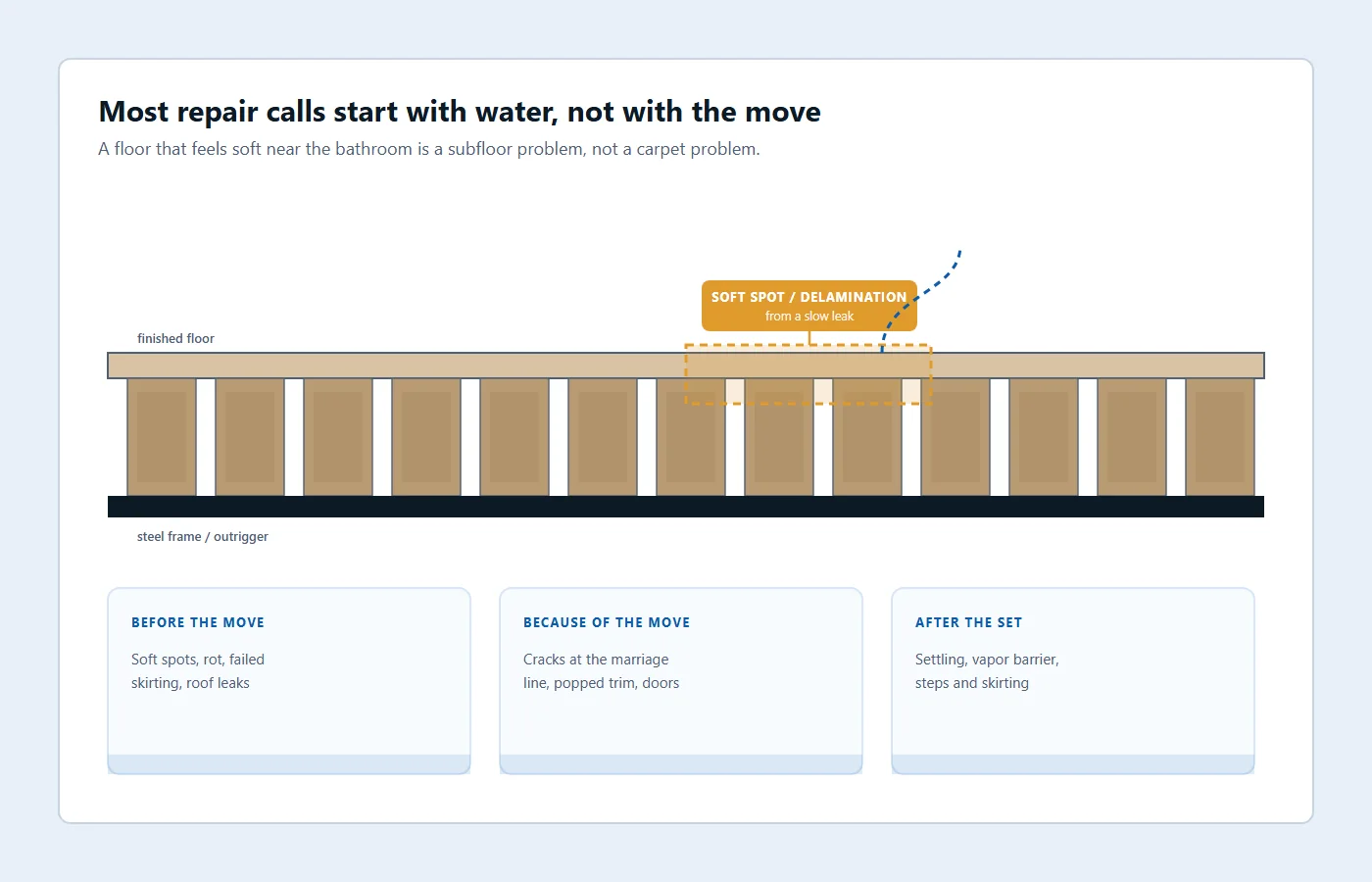
A soft spot is a symptom. The repair is only as good as the diagnosis, because a subfloor replaced over an active leak will be soft again within two seasons. Before any panel comes up, five questions narrow it down.
Where exactly is it?
Near a bathroom, a kitchen sink, a water heater, a washing machine or an exterior door. Each points at a different source. A soft spot in the middle of a hallway with no plumbing nearby usually means a roof or a wall leak tracking along a joist.
Is it worse in wet weather?
If the softness grows after rain, the water is coming from outside the envelope — roof, flashing, siding or a window. If it is constant, it is plumbing.
Does the floor move, or just yield?
A spongy area that flexes is delaminated particleboard. A floor that moves as a slab is a joist or a pier problem underneath, which is a leveling and foundation question, not a flooring one.
Is there a smell or a stain?
Musty odour and dark staining at the seams indicate long-term moisture. That usually means the damage extends further than the soft spot.
What is the age and material?
Particleboard subfloor from the 1980s and 1990s is far less forgiving of a single leak than plywood. Some homes used a composite that crumbles rather than rots, and it fails without warning.
What a subfloor repair actually involves
The finished floor comes up in the affected area, back to the nearest joist on each side. The damaged panel is cut out, the joists are inspected and sistered or replaced if they have lost section, insulation is removed and the cavity is dried, and new flooring is fitted and screwed — not nailed — to the joists. Then the source is fixed, because doing this in the other order is how the same repair gets sold twice.
| Scope | What is involved | Time on site |
|---|---|---|
| Small patch | One panel section, one joist bay, source corrected | Half a day |
| Bathroom floor | Fixture removal, subfloor, resilient flooring, re-set | One to two days |
| Room-scale replacement | Multiple panels, joist repair, insulation, finished floor | Two to three days |
| Joist or beam damage | Sistering or replacement, possible pier correction underneath | Two to four days |
| Widespread rot | Assessment, partial rebuild, possible re-level | A week or more |
Two things make the difference between a repair that lasts and one that does not: whether the cavity was actually dried before it was closed, and whether the water source was fixed first. Neither is visible when the job is finished.
The repairs a move causes, and the ones it exposes
Homeowners often blame the move for damage that was already there. The distinction matters, both for the claim and for what to fix.
Caused by the move
- Cracks at the marriage line or interior corners
- Popped trim, separated drywall tape
- Doors and windows that no longer latch
- Scuffed or cracked siding at strap points
- Loose skirting and steps
- Disturbed vapor barrier underneath
Exposed by the move
- Soft subfloor that was hidden under furniture
- Rot at the rim joist behind skirting
- Corroded frame at the anchor points
- Piers that were never footed
- Old leaks in the roof or around vents
- Failed plumbing connections under the floor
This is exactly why the photograph set before loading matters. A dated picture of the exterior and the interior at handover separates the two categories in minutes, and it protects both the homeowner and the mover.
Maintenance that prevents most of these calls
- Walk the perimeter twice a year. Look at the skirting line, the downspouts, the ground slope and the vents. Most water problems announce themselves here first.
- Keep water away from the home. Gutters that discharge against the skirting, a slope that drains under the frame, or a patio poured above the vapor barrier line.
- Ventilate the crawlspace. Sealed skirting with no ventilation traps moisture and rusts the frame from the outside in.
- Fix plumbing leaks immediately. A slow drip under a sink becomes a subfloor in about a season.
- Re-tension the tie-downs after the first year. New installations settle; a slack strap is a strap doing nothing.
- Check the roof after every storm. Shingle loss and lifted flashing are cheap now and expensive in a year.
A repair budget is cheaper than a repair bill. Setting aside a modest annual amount for maintenance — resealing, re-tensioning, a small plumbing fix — is the difference between a home that holds its value and one that slowly loses it. The same logic applies to the structure itself: the HUD manufactured housing program publishes the construction standards your home was built to, and knowing them tells you what is normal movement and what is a defect.
Repair or replace: how to decide without guessing
The decision is rarely about whether something can be fixed. It is about whether fixing it is the cheaper option over the next five years, and that depends on the cause.
| Problem | Repair when | Replace or escalate when |
|---|---|---|
| Soft floor near a bathroom | The area is small and the leak is found and stopped | Damage reaches a wall or the floor joists are soft over a wide span |
| Skirting damage | Individual panels are cracked or missing | The whole run is brittle, or ventilation was never installed |
| Vapour barrier | Tears and gaps can be patched and lapped | It has disintegrated across the footprint |
| Marriage line gap | It is a gasket and fastener issue | The sections have separated structurally — an engineering question |
| Steps and rails | The base has settled and can be re-set | The stringers or rails are corroded through |
| Roof leak | Flashing or a localised penetration | The covering is at end of life across the whole roof |
What a repair visit should look like
Diagnosis first
Find the cause, not the symptom. A soft floor is a water problem before it is a carpentry problem.
Written scope
What will be opened up, what will be replaced, what will be left alone, and what happens if more is found.
Fixed price, or an hourly rate with a cap
Either is fine. Silence on the subject is not.
The work, photographed
Especially anything that will be closed up afterwards — the repair you cannot see is the one you will be asked about.
Close-up and test
Water tested, floor walked, skirting refitted with ventilation intact.
What you should not do yourself
Some jobs are genuinely DIY-friendly: replacing a skirting panel, clearing a vent, patching a vapour barrier tear you can reach. Others are not, and the dividing line is usually structural or regulated.
- Anything involving gas — connection, leak testing, appliance work. Licensed trade, in every jurisdiction we work in.
- Electrical work beyond replacing a fitting — the panel, the service, the crossover between sections.
- Jacking the home — a home lifted unevenly cracks at the weakest point, and that point is usually a marriage line or a window corner.
- Anchor adjustments — tension is specified, and a slack or over-tensioned strap is worse than none at the wrong moment.
- Structural repairs to the frame — welding or straightening a main beam is engineering work.
Rule of thumb: if the repair changes how the home carries load, contains water or handles power or gas, it belongs to a trade. If it changes how the home looks or how the underside is closed, it is usually within reach. Our leveling page shows what proper jacking involves, and the relevant safety guidance for working under a raised structure is worth ten minutes before anyone crawls underneath.
What repairs actually cost, and why quotes vary so much
Two quotes for the same soft floor can differ by a factor of three, and both can be honest. The difference is scope: one patches the surface, the other removes the damaged subfloor, treats the framing, finds the leak and reinstalls. Ask what is being opened up and what is being replaced, and the two numbers start to make sense.
Labour is the variable that moves most, because access drives it. A repair reachable from the perimeter takes an hour; the same repair in the middle of a double-wide means moving furniture, lifting carpet and working in a crawlspace. That is why a description of the problem, with photographs, gets you a better number than a phone call.
Mobile home repairs: what to ask before you approve the work
Mobile home repairs range from a skirting panel to a subfloor rebuild, and the quote quality decides the outcome more than the price does. Ask these seven before anyone opens anything up.
What causes most mobile home repairs?
Water. Roof penetrations, failed flashing, a vapour barrier with gaps and skirting sealed without ventilation account for most of the damage we see.
How do I get an accurate quote for mobile home repairs?
Send photographs and a description of where the problem is, and say what you have already noticed. Access drives labour, and labour drives the number.
Can mobile home repairs be done while I live in the home?
Usually yes. Floor and subfloor work is the exception, because furniture has to move and the room is unusable for a few days.
Are mobile home repairs covered by insurance?
Sudden damage such as a burst pipe or storm damage often is; gradual deterioration usually is not. Read the policy before assuming either way.
How long do mobile home repairs take?
A skirting panel or a step repair is same-day. A subfloor section with drying time is a week, and a marriage line correction depends on what is found underneath.
Should mobile home repairs be done before a sale?
The ones a surveyor will flag, yes. A documented repair is worth more at negotiation than an undisclosed problem discovered later.
What should a mobile home repairs invoice include?
The scope, what was opened up, what was replaced, photographs of anything closed up again, and the warranty on the work.
Mobile home repairs in short
- Water causes most mobile home repairs on homes older than ten years.
- Mobile home repairs start with the cause, not the symptom.
- Photographs make mobile home repairs easier to quote accurately.
- Mobile home repairs to gas and electrical systems belong to licensed trades.
- Mobile home repairs that change load paths need engineering judgement.
- Skirting and vapour barrier are the cheapest mobile home repairs to prevent.
- Mobile home repairs should be documented before anything is closed up.
- Insurance rarely covers mobile home repairs caused by gradual deterioration.
- Mobile home repairs before a sale are cheaper than a renegotiation after.