Licensed & Insured · Toter Truck & Setup Crew

Mobile Home Transport & Setup, Handled by One Accountable Crew

We move, set, level and anchor manufactured homes across the state and long distance — with the same licensed team from the first phone call to the final inspection. No broker handoffs, no mystery subcontractors, no surprise line items.

  • Fixed written quotes
  • Permits handled for you
  • No credit check financing
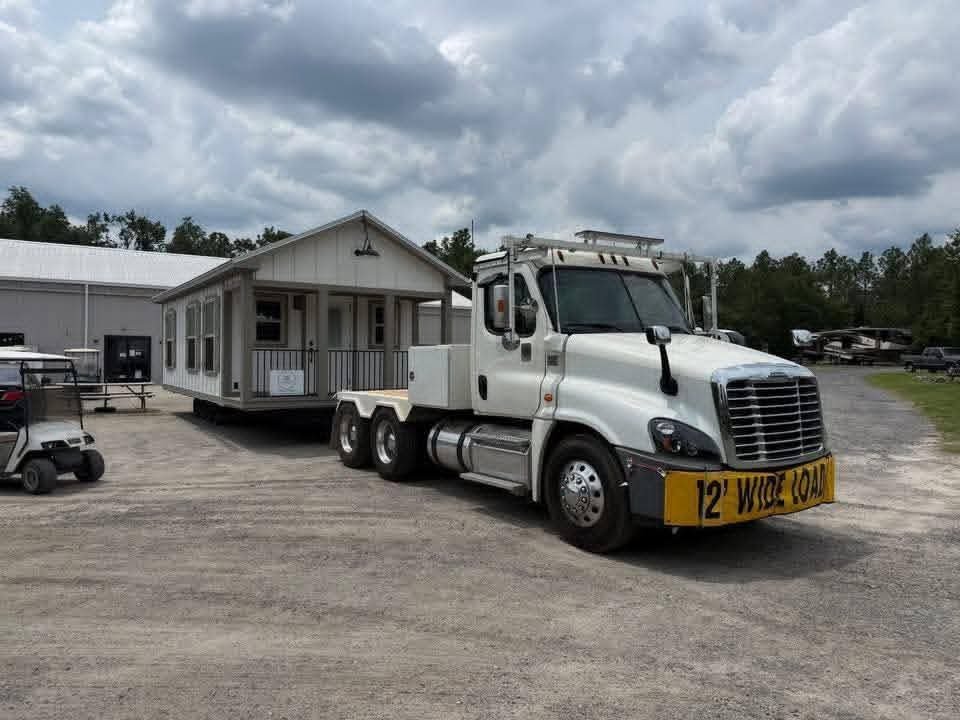
Toter truck hauling a single-wide mobile home on the highway at dusk
Scheduling new moves this week Typical response time: under 2 business hours
Licensed & Insured General liability and cargo coverage on every haul
Experienced & Professional Team Years of single-wide, double-wide and sectional experience
Competitive, Itemized Pricing You see transport, setup, permits and materials separately
On Time, Every Time Confirmed arrival windows and proactive updates en route
No Credit Check Payment plans arranged on your schedule, not a lender’s
We Assist First-Time Owners Walkthroughs for land prep, utilities and inspections
Mobile Home Transport And Setup
Mobile Home Transport & Setup Specialists

A manufactured home move is a logistics job and not a trucking job

Most problems people run into when moving a mobile home do not start on the highway. They start weeks earlier: a route that was never checked for low bridges, a permit filed in the wrong county, a lot that was never graded, or a crew that shows up without the right piers for the soil underneath.

We handle mobile home transport, setup, leveling and anchoring as one connected project. The person who quotes your move is the person reviewing your route, your permit packet and your site plan — and the crew that sets your home is on our payroll, not borrowed from a broker’s contact list. That is why our homes arrive square, level and ready for the utility hookups and inspection that follow.

Whether you need mobile home moving off family land, a double-wide placed on a new foundation, or a fleet of rental units moved across state lines, you get one written scope, one schedule and one number to call when something changes.

1 crew Accountable from pickup to final level check
48 hrs Typical turnaround to a written, itemized quote
100% Permits reviewed before a single wheel turns
0 brokers No middle layer between you and the operator
  • Route survey included — bridge heights, weight limits and escort requirements checked in advance.
  • Site readiness review — access, slope and soil reviewed before moving day, so mobile home leveling problems are caught on paper, not on the lot.
  • Photo documentation — condition recorded at pickup and at delivery.
What We Do

Nine services that cover a mobile home from dirt to doorstep

You can hire us for a single piece of the job or hand us the whole project. Every service below is performed by our own licensed crew.

Mobile Home Transportation

Single-wide, double-wide and sectional hauling on our own toter trucks — local, regional and long distance. Route surveys, oversize permits and escort coordination are built into the plan, not billed as surprises.

Local & long distance Toter truck
See how transport works

Setup & Installation

Placement, blocking, marriage-line joining and final trim for new and relocated homes. We set to the home’s manufacturer instructions and the site plan, then verify square and level before we leave the lot.

Single & double-wide Marriage line
See the setup process

Leveling & Stabilizing

Mobile home leveling done with laser and water-level verification, pier adjustment and re-shimming so doors, windows and floors behave the way they were built to. Out-of-level homes crack drywall and bind frames — this step is what prevents it.

Laser verified Re-shim
Get a quote for this service

Anchoring & Tie-Downs

Mobile home anchoring sized to your wind zone and soil: frame ties, over-the-top straps and ground anchors installed to the home’s data plate and local code, with documentation for the inspector and your insurer.

Wind zone matched Documented
See anchoring standards

Permit Assistance

Oversize/overweight transport permits, state trip permits and county placement paperwork prepared and filed for you. We tell you what your county requires before you buy the land, not after the home is sitting on it.

State & county Trip permits
Get a quote for this service

Inspection & Code Compliance

Pre-purchase, pre-move and post-set inspections with a written photo report: undercarriage, frame, piers, tie-downs, skirting and utility penetrations. If a county inspector is coming, we make sure there is nothing left for them to flag.

Photo report Code ready
Get a quote for this service

Repairs & Maintenance

Belly board and vapor barrier repair, skirting, subfloor and joist fixes, door and window re-hangs, and storm-damage stabilization. Practical repairs that protect the structure instead of cosmetic patches that hide it.

Belly board Skirting Subfloor
Get a quote for this service

Residential & Commercial

One home for a family, or a batch of units for a park, ranch or workforce site. We schedule multi-unit moves in phases so pads, utilities and inspections stay in sequence instead of stacking up.

Parks & ranches Multi-unit
Get a quote for this service

Relocation Services

Full-service mobile home relocation: disconnect coordination, mobile home transport, re-set, re-level and re-anchor at the new address. One schedule covers both ends, so nothing sits in limbo between the old lot and the new one.

Turnkey Both ends covered
Get a quote for this service
Why Homeowners Choose Us

The difference between a broker and an operator

Brokers sell your move to the lowest bidder. Operators own the equipment, employ the crew and answer for the result. Everything below is what that looks like in practice.

One crew owns the whole job

Mobile home transport, setup, leveling and anchoring are performed by the same team. When a home arrives out of level, there is no finger-pointing between a driver and a setup contractor — it is our problem to fix before we invoice.

Quoted from your actual site

Driveway width, turn radius, overhead lines, slope and soil all change the price. We ask for photos and a site address up front so the number in your inbox is the number you pay.

Schedule you can plan around

You get a confirmed load date, a delivery window and a call when the truck rolls. Utility hookups, inspectors and family help can all be booked with confidence.

Itemized, no-surprise pricing

Toter truck, mileage, permits, escorts, piers, anchors and labor each appear as their own line. Compare our quote to anyone else’s and you can see exactly where the difference is.

We know your county’s rules

Placement setbacks, wind zone requirements, foundation inspections and utility releases differ by jurisdiction. We work in them weekly and tell you what to expect before it becomes a delay.

Straight answers, including “no”

If the driveway will not take a 16-foot-wide load, or the lot needs $6,000 of grading first, you will hear it on the survey call — not from a truck driver stuck at the gate.

How It Works

Four steps from first call to move-in ready

No mystery phases. Here is exactly what happens, in order, and what you are responsible for versus what we handle.

1

Tell us the details

Send the pickup address, destination, home size and a few photos of both sites. Ten minutes on the phone is usually enough for us to spot the deal-breakers early.

2

Get a written quote

Within about 48 hours you receive an itemized scope: transport, permits, escorts, setup materials and labor. Ask questions — nothing is buried in a lump sum.

3

Permits and prep

We file transport permits and confirm your site is ready: cleared pad, accessible route, utilities stubbed where the crew can reach them. You get the dates in writing.

4

Move, set and verify

Mobile home setup is finished once the home is transported, placed, leveled and anchored, then photographed and documented. We walk the finished set with you before the crew leaves.

What It Costs

Real mobile home moving costs — before you call anyone

Most companies hide pricing until they have your phone number. Here are the ranges we actually work in for mobile home transport, setup and anchoring. Use them to sanity-check any quote you receive, including ours.

Typical 2026 price ranges

Based on standard access and normal site conditions

Typical mobile home transport and setup price ranges
Service Typical range
Single-wide move, local (under 50 miles) $1,000 – $5,000
Double-wide move, local (under 50 miles) $2,000 – $10,000
Single-wide, long distance $5,000 – $15,000
Double-wide, long distance $10,000 – $20,000+
Per-mile rate, single-wide $5 – $15 / mile
Per-mile rate, double-wide $10 – $25 / mile
Setup, block and level only $800 – $3,500
Anchoring and tie-downs $600 – $2,500
Permits and escort coordination $150 – $1,200

Ranges reflect typical 2026 market pricing and assume clear access, standard wind zone and no major site work. Long-distance rates depend heavily on backhaul availability — a truck already heading your direction costs less than a dedicated run. Your written quote replaces every number above.

Six things that move the price

Distance and routeMileage, tolls, bridge restrictions and whether escorts are required.
Home size and sectionsA 16-foot-wide double-wide needs different equipment than a 14-foot single-wide.
Site accessDriveway width, gate openings, overhead lines and turn radius at both ends.
Permits and escortsState trip permits, county placement approvals and pilot-car requirements.
Site prep and materialsGrading, gravel, piers, footings, anchors and skirting are separate from hauling.
Timing and flexibilityFlexible dates can ride an existing route and save real money on long hauls.
Mobile Home Transportation

What a properly planned mobile home move actually involves

A manufactured home is 14 to 16 feet wide, up to 80 feet long and rides high on a steel frame. That combination means the highway is only half the job. Before the wheels turn, the route has to be measured against every bridge, overpass, sign, tree limb and weight posting between the two addresses — and the home has to be legally permitted for that specific route.

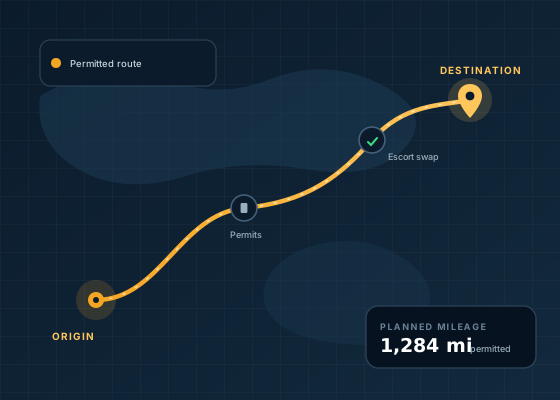
Our mobile home transportation process starts with a route survey. We check vertical clearances, bridge load ratings, construction zones and local restrictions, then build the permit packet: state oversize/overweight permits, trip permits for each state crossed, and county or municipal approvals where they apply. If your route needs a pilot car or a police escort, that is scheduled in advance rather than discovered at the county line.

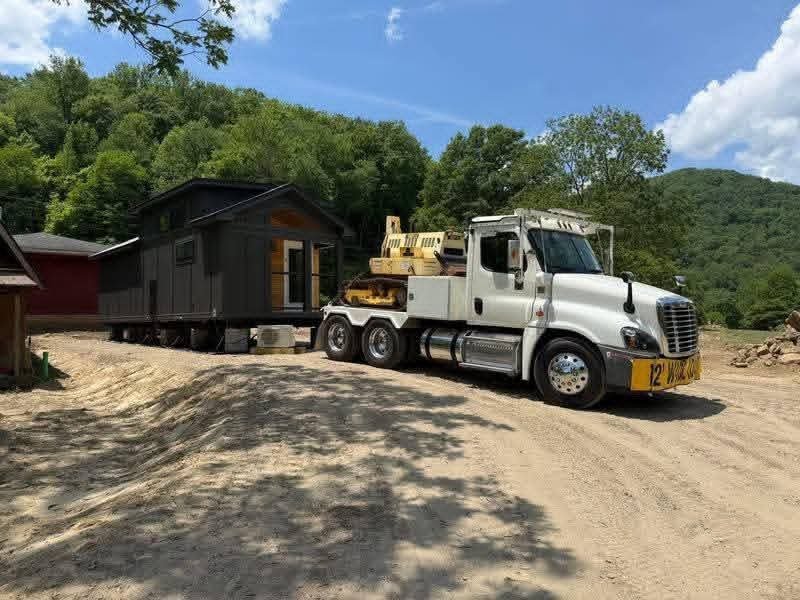
On moving day the home is braced, the hitch and frame connections are inspected before the load is secured to our toter truck. Tires, axles and lights are checked before departure, and the driver communicates position and any schedule change directly with you — not through a dispatch desk that has never seen your home.

  • Route survey — clearance, weight and restriction check before quoting.
  • Permits filed — oversize, overweight, trip and local placement approvals.
  • Escort coordination — pilot cars and police escorts booked where required.
  • Load securement — bracing, hitch inspection and light check at pickup.
  • Photo condition report — recorded at both ends and shared with you.
Planned long-distance mobile home transport route with permit checkpoints and escort swap
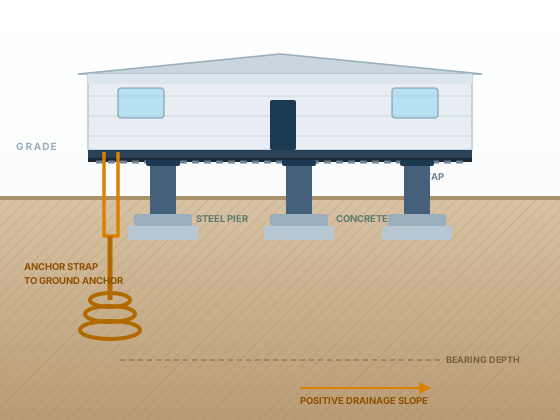
Cross-section showing mobile home steel piers on concrete footings, <a hreg=anchor strap and ground anchor” width=”560″ height=”420″ loading=”lazy” decoding=”async”>
Setup, Leveling & Anchoring

Why mobile home setup is the part that decides how the home lives

A home that is set poorly announces itself within a season. Doors that stick in summer and swing free in winter, cracks above interior corners, a floor that feels springy in the hallway, or skirting that separates from the wall — these are usually foundation symptoms, not house defects.

Mobile home leveling starts with the ground, not the frame. We set homes on properly sized piers with footings that spread the load into the soil, then adjust until the frame is level in both directions. Mobile home anchoring is matched to the home’s wind zone and to the soil we find: frame ties, over-the-top straps and ground anchors with the right embedment for the conditions. On a double-wide, the marriage line is pulled, sealed and checked so the two halves behave as one structure rather than two boxes sitting close together.

Underneath, the vapor barrier is repaired and sealed so ground moisture stays out of the belly, and the site is graded to drain away from the home. Finished skirting goes on last, vented the way it should be. When we are done, we walk the home with you, show you what was installed, and hand over the documentation your inspector and insurer will ask for.

  • Piers and footings — sized to the home and set on prepared, compacted ground.
  • Leveling — verified front-to-back and side-to-side before anchoring begins.
  • Wind-zone anchoring — tie-down count and anchor type matched to your zone.
  • Marriage line — pulled, sealed and verified on double-wides and sectionals.
  • Belly and skirting — vapor barrier repaired, underbelly sealed, skirting vented.
Where We Work

Local moves across the metro — long hauls across state lines

Our mobile home transport trucks run out of the Charlotte metro and cover the surrounding counties weekly. For long-distance mobile home moving we quote the whole route, including states crossed, so there is no renegotiating at the border.

  • Charlotte
  • Concord
  • Gastonia
  • Huntersville
  • Mooresville
  • Kannapolis
  • Salisbury
  • Monroe
  • Statesville
  • Rock Hill, SC
  • Hickory
  • Asheville
  • Greensboro
  • Raleigh
  • Fayetteville
  • Wilmington

Outside these areas? We handle long-distance mobile home relocation to most states. Send us both zip codes and we will confirm routing, permits and pricing within two business days.

Standards & Code Compliance

Installed to the home’s data plate and your local code — and documented

Every manufactured home leaves the factory with a data plate that specifies its wind zone rating and required tie-down pattern. We install to that plate, then to whatever your county adds on top of it.

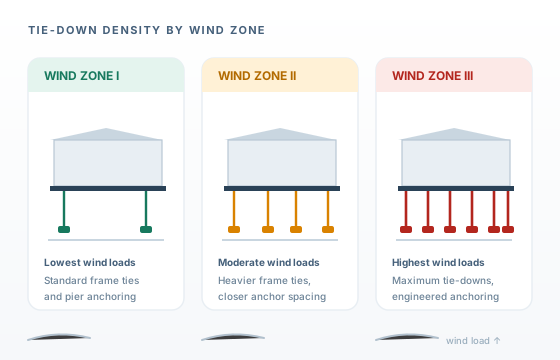
Diagram comparing tie-down and anchoring density for Wind Zone I, Wind Zone II and Wind Zone III mobile homes

Wind zone matched anchoring

Mobile home anchoring requirements differ by zone: Zone I, II and III homes need different tie-down counts, strap types and anchor embedment. We read the data plate rather than installing the same generic pattern on every home.

Manufacturer installation instructions

Pier spacing, marriage-line treatment and load points follow the home’s own installation manual. Deviating from it is the fastest way to fail an inspection and void a warranty.

Local permits and setback rules

Counties set their own setbacks, foundation inspection requirements and utility release steps. We confirm them in writing before the home is scheduled to move.

Photo documentation for inspectors and insurers

Piers, footings, anchors and straps are photographed before skirting goes on, so you have proof of installation when an inspector or underwriter asks.

Customer Feedback

What homeowners say after the home is set

The feedback that matters most to us is the final walkthrough — when the doors close properly and the floor is quiet underfoot.

“They caught that our driveway would not clear the home before we paid a deposit. Two days later the county approved the new route and the move went off without a single delay. First time I have moved a home and not had a surprise bill.”
D. ReyesSingle-wide relocation · 62 miles
“Our double-wide was set on a slope and the previous owner had it blocked with scrap. The crew pulled it, built proper footings, and you can finally shut a bedroom door without lifting it. They photographed everything for the inspector too.”
M. KellerDouble-wide setup and leveling
“We are first-time buyers and had no idea what the county needed. They walked us through the permit, the utility releases and the anchoring requirements on one call. Straightforward people who explain things without talking down to you.”
J. TranFirst-time buyer · new placement
Common Questions

Mobile home transport and setup questions, answered

The questions we hear most often from homeowners, park managers and first-time buyers.

How much does it cost to move a mobile home?

Mobile home transport costs depend on distance and size. A local single-wide move typically runs $1,000 to $5,000, while a local double-wide runs $2,000 to $10,000. Long-distance moves range from about $5,000 to $15,000 for a single-wide and $10,000 to $20,000+ for a double-wide, or roughly $5 to $15 per mile for single-wide and $10 to $25 per mile for double-wide. Distance, home width, site access, permits and escorts are the biggest variables.

How long does it take to move and set a mobile home?

Most local moves are completed in one to two days: pickup and transport on day one, placement, leveling and anchoring on day two. Long-distance moves add transit time based on mileage and permit windows. Setup itself usually takes four to eight hours depending on size, site conditions and whether skirting and steps are included.

Do I need permits to move a mobile home?

Yes, in nearly every case. You will usually need an oversize/overweight transport permit from the state, trip permits for each state crossed on a long-distance move, and a placement or foundation permit from the county or city where the home will sit. Some jurisdictions also require utility releases and a final foundation inspection. We prepare and file the transport permits and tell you exactly what your county wants.

What is the difference between mobile home setup and installation?

Mobile home setup is the physical work of placing, blocking and leveling the home on its lot. Installation is the broader, code-driven process: piers and footings, anchoring and tie-downs to the home’s data plate, marriage-line connection on multi-section homes, vapor barrier and skirting, and the documentation an inspector will review. We treat them as one scope so nothing falls between two contractors.

How is a mobile home anchored, and does wind zone matter?

Mobile home anchoring uses frame ties, over-the-top straps and ground anchors driven to a specified embedment, with the count and spacing set by the home’s wind zone rating and local code. A Wind Zone I home needs far fewer tie-downs than a Wind Zone III home. We read the data plate and install to that rating rather than using one generic pattern on every home.

Can you move a home that has additions, decks or a carport?

Often yes, but attached structures usually have to be separated first. Additions built on their own foundation, screened rooms, decks and carports are typically removed and either rebuilt or replaced at the destination. We assess those during the site survey and price the demolition or detachment separately so there are no surprises.

What do I need to have ready before the crew arrives?

Clear vehicle access to the home, remove fences or gates that block the route, trim low limbs, and make sure the destination pad is cleared, compacted and accessible. Utilities should be disconnected and capped by a licensed trade before pickup, and the home should be empty of furniture and valuables. We send a written prep checklist with every confirmed booking.

Do you offer payment plans without a credit check?

Yes. We can split a move into scheduled payments tied to milestones — booking, pickup and final set — without running a credit check. Terms depend on the total scope and lead time, so ask about it when you request your quote and we will lay out the options in writing.

Request Your Quote

Tell us where the home is — and where it needs to go

Send the pickup address, the destination, the home size and a couple of photos of each site. You will get a written, itemized mobile home moving quote within about 48 hours, and a straight answer about anything that could slow the move down.

  • No obligation, no pressure callbacks
  • Written scope before any deposit
  • Financing options without a credit check
Call 312-940-1280 Email the details

Mon–Sat · 7:00am – 6:00pm
Replies within 2 business hours

  • Licensed & insured
  • Permits handled
  • Code-compliant anchoring
  • No credit check