


Mobile home relocation is the whole job: disconnect it, move it, set it, anchor it, reconnect it, pass inspection and hand over the file. Done as separate contracts, the handoffs are where schedules die. Done as one project, there is a single sequence, a single quote and one person accountable when the site is not ready.
Table of Contents
Below is the full sequence, the realistic timelines, the line items a quote should contain and the approvals that must happen in order. Mobile home relocation fails on sequencing far more often than on hauling, which is why this page is organised as a project rather than a price list.
This page is the master sequence. Each stage links to the detailed service page.
The relocation sequence
| Phase | Work | Owner |
|---|---|---|
| 1. Feasibility | Home inspection, dimensions, roof height, frame condition, destination site access | Us |
| 2. Approvals | Park or landlord approval, land-use confirmation, transport and installation permits | Us with you |
| 3. Utilities out | Water, sewer, electric, gas disconnected and capped; meters closed | Us coordinating licensed trades |
| 4. Teardown | Skirting, steps, decks, awnings and additions removed; sections separated; interior secured | Us |
| 5. Transport | Route survey, escorts, haul, staging at destination | Us |
| 6. Site prep | Grade, pad, pier layout, utility stubs | Us or your site contractor |
| 7. Set and level | Piers, blocking, marriage line, laser level, stabilisation | Us |
| 8. Anchor | Tie-downs to wind-zone pattern, hardware to load spec | Us |
| 9. Utilities in | Water, sewer, electric, gas reconnected to code | Us coordinating licensed trades |
| 10. Finish | Skirting, steps, decks, site clean | Us |
| 11. Inspect and hand over | Code inspection, certification filing, documentation pack | Us |
What it costs to relocate a mobile home
2026 industry ranges put a full relocation at roughly $4,000–$8,000 for a single-wide with a straightforward site, and $10,000 and up for a double-wide. Long distances and complex sites push a single-wide past $15,000 and a double-wide past $25,000. A triple-wide with crane work and multi-state permitting can exceed $35,000.
| Line item | Typical share of the total |
|---|---|
| Teardown and site disconnect | $500–$2,000 |
| Transport (toter, escorts, fuel) | Largest single line, distance-driven |
| Permits | Pass-through, jurisdiction-set |
| Set, block, level | $1,500–$5,000 |
| Anchoring | $500–$3,500 |
| Skirting, steps, decks | $700–$4,000 |
| Utility reconnection | Trade-dependent |
| Inspection and filings | Jurisdiction-set |
The homeowner checklist, in order
- Confirm the land can take the home. Zoning, setbacks, utility availability, park approval and any deed restrictions.
- Settle the title and the HUD tag. Missing tags or title defects stall both the move and the financing.
- Get the inspection. Know what you are moving before you book a truck.
- Book permits early. Three to ten business days is normal; longer for superloads.
- Order utilities out and in. Disconnect dates and new-account dates are separate bookings with separate lead times.
- Prepare the site. Clear access, pad, drainage. A truck that cannot reach the pad is a wasted day.
- Arrange insurance. Confirm coverage in transit and from the moment the home is set.
- Keep the file. Permits, inspection report, level readings, anchor layout, photos and the certification filing.
First-time buyers: the sequence nobody explains
Buying a manufactured home for the first time involves three approvals that are not the same thing: the home has to be movable, the land has to accept it, and the installation has to be permitted. Add financing and insurance, and the order matters.
A practical order: land and zoning first, then home inspection and title, then transport and installation permits, then utilities, then insurance, then the move. Reversing any two of those creates a cost. Buying the home before confirming the land can take it is the most common and most expensive mistake we see.
We do not run a credit check to quote a relocation, and we will sit through the sequence with you before you commit to a date.
What a mobile home relocation quote should contain
A full-service mobile home relocation quote is a project budget, not a haulage rate. It should show:
- Inspection and feasibility, if not already done.
- Teardown labour, including decks, steps, skirting and additions.
- Utility disconnects and reconnections, with the trades named.
- Transport, escorts, fuel and permits, itemised.
- Site preparation, separately, because it depends on your ground.
- Set, block, level and anchor.
- Skirting, steps and finish carpentry.
- Inspection fees and the certification filing.
- Standby and weather contingency, stated as a policy rather than a surprise.
Mobile home relocation timelines by distance
| Move | Realistic total | What dominates |
|---|---|---|
| Local single-wide, prepared site | 2–3 weeks | Permit and utility scheduling |
| Local double-wide | 3–4 weeks | Two hauls plus the marriage line |
| Intrastate, 200+ miles | 3–6 weeks | Permits per state and travel windows |
| Interstate | 4–8 weeks | Multi-state permits and inspection capacity |
| Triple-wide or restricted access | 6–10 weeks | Crane scheduling and route approvals |
Mobile home relocation risks and how they are managed
Permit delay. Filed early, tracked against the delivery window, and re-filed if the window moves.
Site not ready. Surveyed before the truck is booked, with a written go/no-go date.
Hidden damage. Found in the pre-move inspection, priced before the contract rather than after.
Weather. Built into the schedule as a stated risk, not absorbed silently by the homeowner.
Utility disconnect. Booked as a date, confirmed in writing, with a fallback if the provider slips.
Mobile home relocation for first-time buyers
The sequence is the service. Land and zoning, inspection and title, permits, utilities, insurance, then the move. A mobile home relocation that starts with the truck is a project with three unresolved approvals behind it, and those approvals are exactly what delay a handover.
We will walk the sequence before you commit to a date, at no charge. If the plan does not hold together, we would rather say so at that stage than at the site. Request a relocation quote.
A mobile home relocation is a chain of approvals with a truck in the middle. Land, title, inspection, permits, utilities, insurance, move, set, inspect. Reverse any two and you create a cost. We would rather spend an hour mapping that chain with you before you commit than discover the gap on the morning the crew arrives. If your plan already has a date that cannot move, start with the permits — they are the item most likely to decide it.
Quick answers about mobile home relocation
- What is included? Teardown, disconnect, permits, haul, set, level, anchor, reconnect and inspection close-out in a full mobile home relocation.
- How long? Two to four weeks locally, four to eight weeks for a mobile home relocation across state lines.
- Can I split the scope? Yes, but a partial mobile home relocation puts the handoff risk back on you.
Frequently asked questions
How long does a full relocation take?
Two to four weeks from approval to handover for a local single-wide, assuming permits and utilities are ready. Interstate moves and double-wides commonly run four to eight weeks.
Can you relocate a home into a park?
Yes, with the park’s approval and their access rules. Many parks require their own installation standards on top of state code.
What if the home cannot be moved?
We will tell you before you pay for permits. Frame condition, roof height, additions and title problems are the usual reasons, and each one is checkable in advance.
Do you handle the utility companies?
We coordinate the disconnects and reconnects and provide the documentation they ask for. Licensed trades perform the actual electrical, gas and plumbing connections.
Relocation planning: the order that saves money
Most relocation problems are sequencing problems. Money is spent on the move before anyone confirms the home can legally sit where it is going, or the destination is prepared before the permit is issued. The order below is the one that avoids paying twice.
Confirm the destination can take the home
Zoning, park approval, HOA, setback, septic or sewer capacity, and the wind zone. This costs almost nothing and can end the project before you spend anything.
Confirm the home can be moved
Age, condition, roof type, width, and whether the frame will survive the haul. A pre-move inspection answers this.
Confirm the title and the liens
A home with an unresolved lien does not move legally. Sort the paperwork before booking a crew.
Price the route
Survey the access at both ends, measure the height loaded, and identify the permits and escorts the route requires.
Book the sequence, not the date
Utility disconnect, move, set, utility connect, inspection. Each has a lead time, and they have to be booked in the right order.
Prepare the site before the truck arrives
Graded, drained, pads set, access clear. A crew waiting on a site is a crew you are paying to wait.
What relocation costs beyond the haul
| Item | When it applies | Why people forget it |
|---|---|---|
| Disconnection and reconnection fees | Always | They are paid to the utility, not the mover, and arrive weeks apart |
| Permits, escorts and pilot cars | Most moves | Quoted separately, and they scale with width and route |
| Site preparation and grading | Almost always | Often discovered after the quote is accepted |
| Piers, footings and anchoring | Always | Priced per pier and per anchor, and the count depends on the zone |
| Skirting, steps and decks | Always | Not part of a set, and not covered by most quotes |
| Repairs the move exposes | Frequently | Soft floors and rot are only found once the home is empty |
| Storage if the destination is not ready | Sometimes | Nobody plans for a two-week gap, and it is expensive |
| Temporary accommodation | Sometimes | The gap between disconnect and occupancy is real |
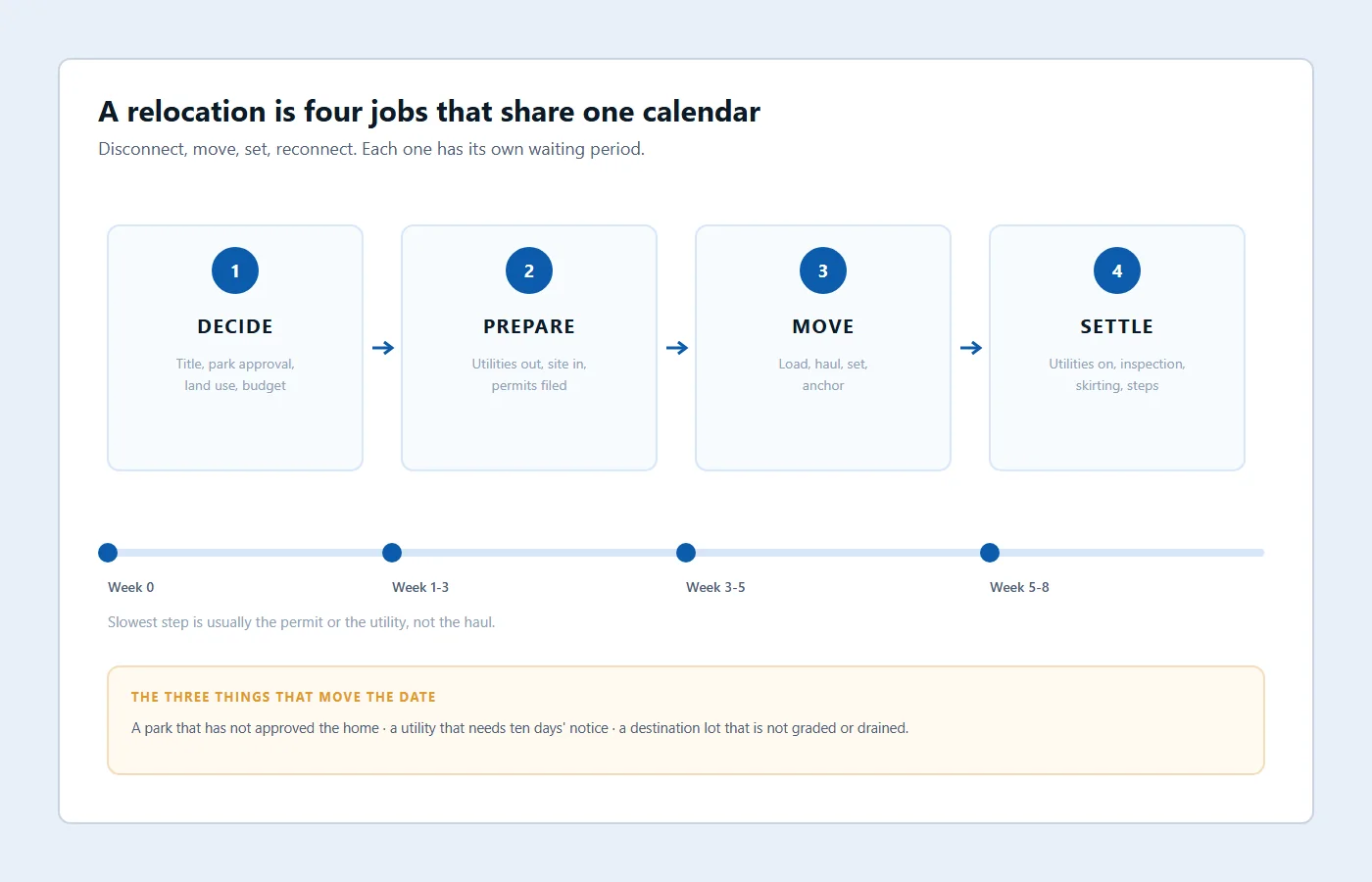
Relocating a home you have not bought yet
Buying a used manufactured home to move onto your own land is one of the cheapest routes into homeownership in much of the country, and one of the easiest ways to lose money. Three checks protect the purchase.
The home is movable
Width, height and condition. A 16-foot-wide section with a pitched roof may need the roof removed, which changes the economics. A home with a failing frame may not be movable at all, and no quote fixes that.
The home is legally yours to move
Title, liens, taxes and tags. In some states a manufactured home is titled as a vehicle until it is converted to real property, and the conversion matters for financing, insurance and resale. Ask which it is, and get it in writing.
The destination is ready for it
Zoning, septic capacity, utility availability, access for a toter, and the wind zone. A parcel that looks perfect in a photograph can be unusable for a manufactured home, and the county is the only authority that can tell you for certain.
Budget the landing, not just the purchase. The home is often the cheapest part. Site work, foundation, set, anchoring, utilities and skirting frequently exceed the price of the home itself, and a purchase decision made without those numbers is a decision made on half the information.
If the move is for work, or for family
Relocation is often driven by a job, a divorce, an inheritance or a death in the family, and those moves have their own pressures: a deadline that cannot move, an estate that has to be settled, a home that has to be vacated by a date in a lease.
What helps in those cases:
- Say the deadline first. A realistic calendar is more useful than a low number, and it lets you plan storage or temporary housing before you need it.
- Get the whole scope priced at once. Transport, set, utilities and skirting as separate lines, so nothing appears later.
- Ask who else has to act. The park, the utility, the county, the lender. Every one of them is a lead time you cannot compress.
- Keep one file. Title, permits, photographs, inspection and warranty in one place, because you will be asked for them by people who were not involved.
None of that makes a relocation simple. It does make it predictable, and predictable is what you need when the rest of the situation is not.
A week-by-week plan for a relocation
Relocation has a rhythm, and the rhythm is set by permit lead times rather than by the crew. Plan backwards from the date you need to be in the home, and the sequence becomes obvious.
| When | What happens | Who owns it |
|---|---|---|
| 6–8 weeks out | Survey, quote, confirm the destination will accept the home | You, with the destination county or park |
| 4–6 weeks out | Permits filed, escorts booked, utility disconnects requested | Transporter, with you for utility accounts |
| 2–3 weeks out | Site work at the destination: pad, grading, stubs | Site contractor |
| 1 week out | Teardown items removed, home prepared, final access check | Transporter and you |
| Move window | Load, haul, deliver, set, level, anchor | Transporter |
| Move + 2–10 days | Marriage line, utilities, skirting, steps, inspection | Installer and trades |
| Move + 2 weeks | Closeout file issued, warranty registered | Transporter |
Two of those rows are routinely underestimated: the destination approval, which can take weeks in a county that requires a hearing, and the utility disconnect, which is often on a two-week queue. Both sit before the truck moves and both are outside the mover’s control.
Relocating versus selling where it stands
Sometimes the arithmetic favours not moving the home at all, and it is worth doing honestly before committing.
- Move it when the home is sound, the destination is free, and the alternative is buying a replacement at a higher price than the move.
- Sell it in place when the home is old, the destination needs significant site work, or the loaded height forces a roof removal on a low-value structure.
- Consider a trade-in when a dealer will take the home against a new one and the transport is the main obstacle. Dealers price this in; ask before you assume it is unavailable.
The calculation is: move cost plus site work plus connection plus any repair, against the value of the home in its new location minus its value where it sits. If those two numbers are close, the decision is about time and risk rather than money. Our cost breakdown gives you the line items to put in that sum, and the transportation page covers what the haul itself involves.
Risk register: what goes wrong on relocations, and the mitigation
| Risk | Early warning | Mitigation |
|---|---|---|
| Permit delay | Route crosses a state with a review queue | File early; keep a route alternative |
| Destination not ready | Pad not poured, utilities not stubbed | Hold the move, or budget for storage |
| Weather | Seasonal patterns in the region | Build a buffer into the window |
| Damage in transit | Previous repairs, brittle siding | Photograph before, pad contact points |
| Inspection failure | An installer who has not worked that county | Confirm local experience in writing |
| Cost creep | A quote with no exclusions list | Firm price after survey, approval for additions |
None of these are unusual. What separates a smooth relocation from a difficult one is that all six were discussed before the deposit, rather than discovered one at a time.
Mobile home relocation: seven questions before you commit
Mobile home relocation is a project with a schedule, not a single booking, and the schedule is set by permits and site readiness. These are the questions that keep it on track.
How early should mobile home relocation be planned?
Six to eight weeks for a straightforward move. Destination approval and utility disconnects are the two steps that most often set the date back.
What does mobile home relocation include?
Survey, permits, escorts, loading, hauling, delivery, set, level and anchor, plus the closeout file. Site work and utility connections are separate scopes.
Can mobile home relocation cross state lines?
Yes, with permits filed per state and installation credentials confirmed at the destination. The second part is where broker arrangements usually fail.
How much does mobile home relocation cost?
It depends on distance, dimensions, permit thresholds and site work. A range from a phone call is a placeholder; a survey produces the number.
What can delay mobile home relocation?
Permit review, a destination pad that is not ready, utility disconnects, and weather. All four are predictable and all four are routinely missed.
Is mobile home relocation cheaper than buying a replacement?
Sometimes, and the arithmetic is worth doing: move cost plus site work plus repairs against the value of the home in its new location.
What should I keep after mobile home relocation?
The whole file: permits, level readings, anchor records, photographs, certification and warranty. It is what protects the home’s value at resale.
Mobile home relocation in short
- Mobile home relocation needs six to eight weeks of planning.
- Destination approval is the first gate in mobile home relocation.
- Mobile home relocation permits are filed per state segment.
- Utility disconnects are the commonest delay in mobile home relocation.
- Mobile home relocation includes set, level and anchor when it is one contract.
- Weather stops mobile home relocation on wet ground, and rightly so.
- Mobile home relocation paperwork protects the home’s value at resale.
- Sometimes mobile home relocation is the wrong answer, and selling in place is right.
- Mobile home relocation across state lines needs installation credentials at the destination.
The installation standard that applies once the home arrives is published in 24 CFR Part 3285, and the destination county enforces it. For the site work that has to happen before the haul, the setup and installation guide is the place to start.