


Mobile home transportation is a permitted oversize haul, not a tow. The load is 14 to 18 feet wide, up to 80 feet long, frequently over the legal height limit, and worth more than the truck pulling it. Getting it right comes down to four things: a route that is legal, a trailer and hitch rated for the frame, a secure pattern that does not crush the home, and a delivery plan that matches the site.
Table of Contents
Below is how a mobile home transportation job is planned, what the load actually weighs and measures, what each state will require, and where cheap quotes go wrong. It is written for the homeowner who wants to understand the haul rather than take a dispatcher’s word for it.
We move single-wide, double-wide and triple-wide manufactured homes locally and across state lines, and because we also set and anchor homes, the haul is planned around what the site crew will need at the other end.
What we check before we quote a haul
- Dimensions. Width, length, height at the highest fixed point, and the frame configuration. Height is what kills schedules, because a home that measures 14 feet 8 inches when the state allows 14 feet 6 inches needs the roof removed.
- Weight and axle loading. Section weight against the toter and trailer rating, with the weight distributed so the frame is supported at the designated points, not the skirting.
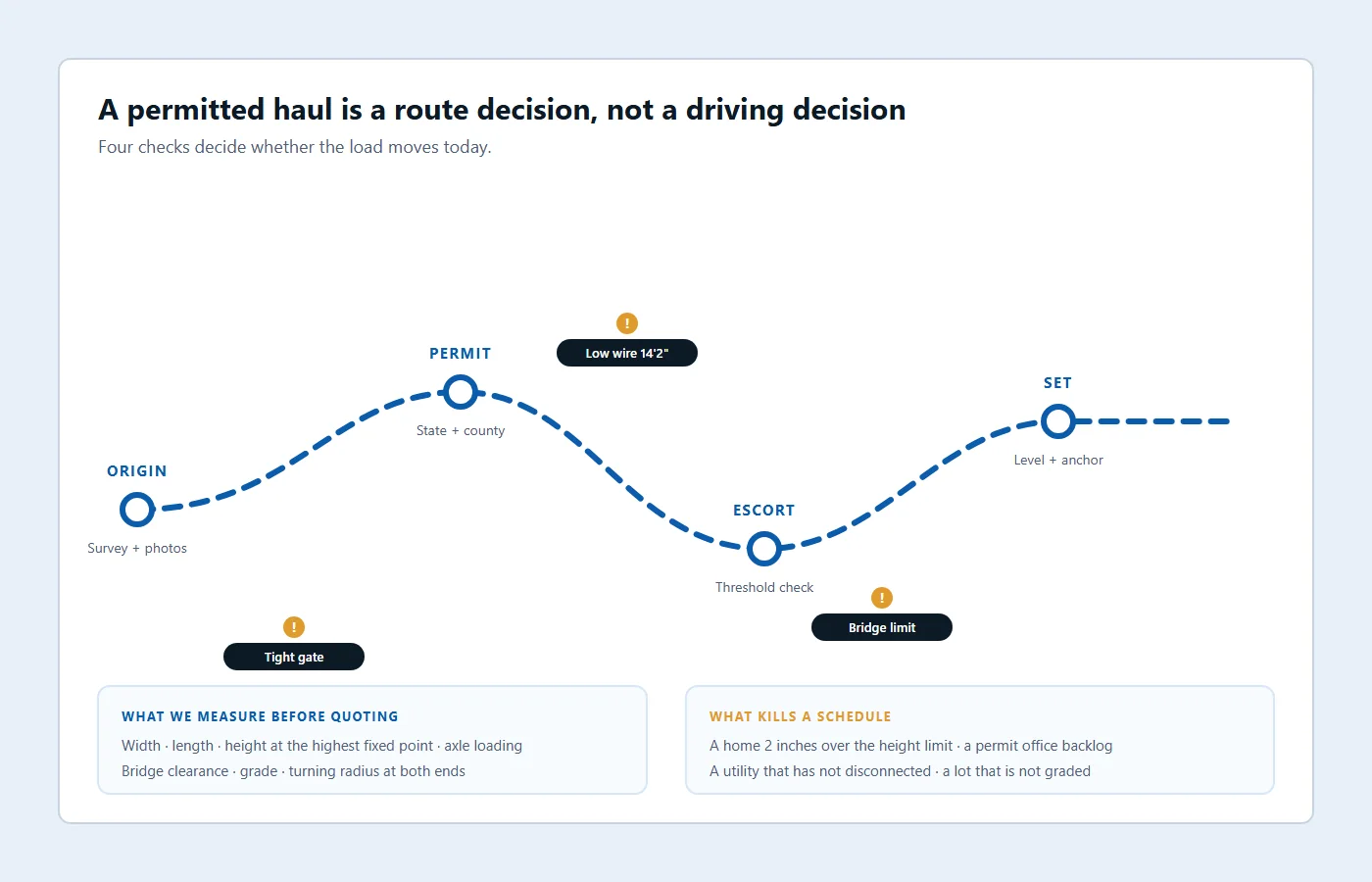
- Route survey. Bridge clearances, low wires, restricted corridors, construction embargoes, steep grades and the turning radius at both ends.
- Site access. Gate width, overhead obstructions, surface condition, approach angle and where the truck can stand without sinking.
- Escort thresholds. Where pilot cars or police escorts are required, and whether the delivery window allows them to be booked.
How a mobile home is secured for transport
Securing is not “strap it down hard”. Excess tension distorts walls and pops seams; too little lets the section walk on the frame. We use the manufacturer’s designated tie points and the frame’s rated locations, with blocking at the marriage line and protection at every point where a strap or cable meets siding or trim. Interior doors, cabinets and appliances are secured, and loose items are removed rather than left to become projectiles.
A double-wide is two separate loads. Each section travels independently, which means two permits in most states, two escorts above certain dimensions, and a planned sequence so both halves arrive with the crane or winch support available on the same day. A triple-wide adds a third haul and tighter sequencing.
Mobile home transportation costs by size and distance
| Home type | Typical transport range (2026) | What drives the spread |
|---|---|---|
| Single-wide, under 50 miles | $1,000–$5,000 transport only | Minimum mobilisation charge, site access, permit fees |
| Single-wide, 200+ miles | $5,000–$15,000 | Per-mile rate, escorts, fuel, driver days |
| Double-wide | $3,500–$18,000+ | Two hauls, two permit sets, escorts, join labour |
| Triple-wide | $20,000–$35,000+ for a full move | Three sections, crane or winch support, sequencing |
Per-mile rates in 2026 generally land between $4 and $7 for the toter, with escorts at $1.50–$3.50 per mile each. Short moves often hit a minimum, which is why a 5-mile move and a 25-mile move can price similarly. Our relocation page shows how transport, set and anchors combine into one itemised quote.
Long-distance and interstate moves
An interstate haul needs permits from every state the load passes through, and each state sets its own width, height, length, escort and travel-time rules. Some issue trip permits online in minutes; others want applications days ahead. Some restrict weekend travel; some require a police escort in specific metro areas.
This is where cheap quotes fail. A carrier who prices the shortest route and discovers a 14-foot clearance on day two has to detour, re-permit and re-schedule — and the homeowner absorbs the delay. We price the legal route from the start and give you the travel window in writing. See how we handle permits.
What can stop a move
Being direct about this saves everyone money:
- Frame corrosion or damage. If the frame cannot take the load, the home should not travel. A pre-move inspection settles it. Inspection service.
- Additions and attachments. Porches, carports, room additions and decks built onto the home must be removed, and unpermitted additions often hide structural surprises.
- Roof height. Over the state cap, the roof comes off. That is a separate scope with its own labour and re-roof cost.
- Site not ready. Soft ground, no pad, no utility clearance, or a gate the home cannot pass. Setup and installation can include the prep, but it has to be scheduled.
- Title and HUD tag problems. Missing HUD labels or data plates can stall financing and, in some states, the move itself.
What a mobile home transportation quote should include
A mobile home transportation quote is only useful if it can be compared. Ask for these lines separately, even if the total is what you care about:
- Mobilisation and minimum charge. Every haul has a floor price; a five-mile move and a twenty-five-mile move often cost the same.
- Mileage at the permitted route distance, not the map distance.
- Escort vehicles, with the number required and the per-mile rate.
- Permit fees per state, listed as pass-through.
- Detach and reattach if the home has to be separated from steps, decks or skirting.
- Standby time if the site is not ready when the truck arrives.
- Insurance and declared value.
Mobile home transportation priced as a single lump sum usually hides the standby line and the second escort, which is why the final invoice moves. Our permit page explains which of these are jurisdiction-set.
Mobile home transportation by home type
| Home type | Loads | What changes |
|---|---|---|
| Single-wide | One | Simplest permit profile; the whole cost sits in distance and access |
| Double-wide | Two | Two permits, two escorts in many states, plus a marriage-line join on site |
| Triple-wide | Three | Sequencing and crane support; site access often decides feasibility |
| Modular | One to several | Different code path, more crane work, tighter delivery tolerances |
| Park model | One | Lighter load but often awkward dimensions and tight park access |
How we plan a mobile home transportation job
- Measure on site. Width, length, height and weight class, with photographs.
- Survey the route. Clearances, restrictions and the turning radius at both ends.
- Confirm permits and escorts for every jurisdiction, then book the travel window.
- Prepare the home. Secure interior, protect surfaces, confirm the frame’s tie points.
- Load and secure to the frame’s designated points, with protection at every contact.
- Haul and deliver inside the permitted window, with the project manager on site.
- Stage for the set crew so the next stage does not wait on the truck.
That sequence is why our mobile home transportation pricing holds up after delivery. Nothing is discovered at the scale house.
Mobile home transportation mistakes that cost real money
Quoting from a brochure. Manufacturer dimensions exclude additions, roof features and the trailer deck height. A load measured on paper is a load measured wrong.
Ignoring the approach. The last hundred feet cause more damage than the first hundred miles: soft ground, a tight gate, a low wire, a slope the truck cannot climb loaded.
Stacking escorts into one line. Two escorts at $2.50 per mile on a long haul is a real number, and it should be visible before you sign.
Booking the delivery before the site is ready. A standby day plus a re-mobilisation is more expensive than moving the date.
Transportation and the rest of the job
Mobile home transportation does not end at the wheels. If the home is going onto a new site, the setup and installation scope, the anchoring and the inspection all depend on how the home arrives: square, undamaged and staged in the right place. That is the practical argument for one crew, and it is why most of our clients buy the haul and the set together.
If you take one thing from this page, take the measurement. Mobile home transportation priced without a measured height, a surveyed route and a photographed approach is an estimate that will be revised — usually after the truck is booked. Ask for the numbers in writing, ask which states the permit set covers, and ask who is standing on site when the home lands. Those three answers tell you more about a mobile home transportation company than any review score.
Quick answers about mobile home transportation
- Single or double? Mobile home transportation pricing changes with the number of sections, not just the distance, because each section is a separate haul and permit.
- How long? A local mobile home transportation job takes two to three working days once permits are in hand; interstate work runs longer.
- Roof on or off? It depends on measured height against the state limit, and the measurement happens before the mobile home transportation quote is written.
Frequently asked questions
How much does it cost to transport a mobile home per mile?
Roughly $4 to $7 per mile for the toter in 2026, plus $1.50 to $3.50 per mile for each required escort. Short moves usually hit a minimum charge, so the effective per-mile cost is higher under about 30 miles.
Do you move homes that are already in a park?
Yes. Park moves need the manager’s approval, a utility disconnect schedule and often a specific travel window. We coordinate with park management directly.
Can a mobile home be moved with furniture inside?
Light, secured items can usually stay. Anything loose, heavy or glass should be removed. The load has to stay within weight limits and nothing can shift against a wall during braking.
How far in advance should I book?
Two to four weeks is comfortable for a local move once permits are approved. Interstate moves and peak season (spring through early autumn) benefit from four to six weeks.
What the load actually weighs, and why the axle number matters more than the total
A single-wide home built in the last twenty years typically leaves the factory between 10,000 and 22,000 pounds depending on length, wall construction and whether it is a HUD-code or modular build. A double-wide lands between 20,000 and 40,000 pounds across both sections. A triple-wide can pass 45,000. Those figures are quoted constantly, and they are almost never the number that decides whether the haul is legal.
The number that decides it is the load on each axle group. A toter carries part of the section on its own deck and pulls the rest on a trailer, and the frame of a manufactured home is designed to be supported at specific points — the main I-beams, not the outriggers, not the skirting, not the floor. Load the section so the weight sits between the designated pick points and the frame behaves. Load it so a pier line takes a disproportionate share and you can bow a beam that no amount of leveling will fix afterwards.
How we check it before the truck arrives
- Manufacturer data. The data plate and the title carry the shipping weight and the gross vehicle weight rating of the home as built. Anything added since — a porch, a second bathroom, a shingled roof over — is estimated from the drawings and, where it matters, measured.
- Axle capacity. The toter, the trailer and the hitch are rated separately. The lowest of the three governs, and it is checked against the loaded weight, not the empty weight.
- Tongue and pin weight. Distributed so the towing unit stays planted at highway speed without overloading its rear axle.
- Height under load. A trailer that squats changes the clearance at every bridge on the route, which is why the height is measured with the home on the trailer, not on the lot.
The practical consequence: if a mover quotes you without asking for the data plate, the year, the length and the number of sections, the number they give you is a guess with a deposit attached. Weight and height are the two inputs that turn a guess into a quote.
Interstate moves: what changes when you cross a state line
Every state issues its own oversize permit, sets its own width, height and length ceilings, and decides for itself when an escort or a height pole is required. A route that is legal in one state can be illegal ten miles later, which is why an interstate haul is planned as a series of state segments rather than a single line on a map.
The four things that differ most between states
| Variable | Why it differs | What it costs you |
|---|---|---|
| Maximum width without special handling | Most states permit 14 to 16 feet on a standard oversize permit; a few require a superload or a separate engineering review above a lower threshold. | Time. A superload review can add days or weeks, and it can force a route change. |
| Height ceiling | Commonly 14 feet to 14 feet 6 inches, but the measurement method and the tolerance vary, and some corridors are lower. | Roof removal, or a longer detour to a corridor with more clearance. |
| Escort thresholds | Width, length, height and route type all trigger escorts in different combinations, and some jurisdictions require a police escort on certain roads. | A pilot car and a second crew member, booked and paid for. |
| Travel windows | Night movement, weekend movement and holiday restrictions are set locally, often by the same office that issues the permit. | Scheduling. A legal load can still be illegal at 6 p.m. on a Friday. |
We file per state and keep the permit set in the cab, matched to the route actually driven. If a route changes mid-haul — a closure, a weight restriction posted after the permit was issued — the permit set changes with it, and the haul waits until it does. The federal installation standard behind all of this is published in 24 CFR Part 3285, and the state DOT oversize office is the authority for the permit itself.
Loading, securing and the damage that shows up a week later
Most transport damage is not a crash. It is abrasion, compression and flexing: a strap that rubs through siding over four hundred miles, a corner that takes the load of a chain, a marriage line that opens because the two halves were allowed to move against each other. The pattern is decided in the first hour, and it shows up after delivery.
How a section is protected
- Contact points padded. Straps and chains never touch siding directly. Pads, corner protectors and soft slings sit between the hardware and the home.
- Secured to the frame. The tie-down pattern pulls against the steel frame at the designated points, so the structure carries the load instead of the wall panels.
- Straps tensioned, then re-checked. Hardware settles in the first fifty miles. A load that is not re-checked is a load that loosens.
- Loose items removed or secured. Steps, skirting panels, awnings, antennas and anything bolted to the exterior travel separately or come off entirely.
- Photographed before and after. Every section, every elevation, every existing mark. This is the file that settles a damage conversation in ten minutes instead of ten weeks.
Contents do not travel. A manufactured home is not a shipping container. Anything left inside shifts under braking and acceleration, and it is not covered by transport insurance. Empty the home before the crew arrives, including the refrigerator, the washer and anything glass.
What a fair transport quote looks like, line by line
A single number tells you nothing. Two quotes for the same move can differ by forty percent and both be honest, because one includes the set and one does not, or one assumed a route the other priced properly. Ask for the lines, then compare the lines.
| Line | What it should say | Red flag if it is missing |
|---|---|---|
| Mobilisation | Toter, trailer and crew to the origin, with the distance stated | “Trucking” as one lump with no distance |
| Permits | Per state, with the fee and who files | Permits described as “included” with no amount |
| Escorts | Number of vehicles, days and rate | Escort cost discovered on the day of the move |
| Loading and securing | Pads, straps, labour, disconnection of steps and skirting | An hourly rate with no estimate of hours |
| Transport | Per mile or per segment, with the route named | A per-mile rate that ignores state segments |
| Set, level and anchor | Separately priced, with pier and anchor counts | “Set included” with no scope |
| Declared value | The coverage limit stated in writing | No declared value at all |
If the total is the only number on the page, ask for the breakdown before you pay a deposit. A mover who cannot produce it either does not know the job or does not want you to see the margin.
Before you book mobile home transportation: seven questions
These are the questions that decide whether mobile home transportation goes to plan, and the answers we give on the phone. Read them before you compare quotes, because a company that cannot answer all seven is not quoting the same job.
What does mobile home transportation include as standard?
Measured dimensions, a route survey, state permits, escorts where the load triggers them, loading and securing, delivery, and a documented handover. Set, level and anchor sit outside transport unless the quote bundles them.
How far in advance should mobile home transportation be booked?
Four to six weeks is comfortable for a straightforward interstate move. Permit review times set the floor, and peak season adds to them, so a firm date needs a filed permit behind it.
Can mobile home transportation be priced per mile?
It can be quoted that way and it should not be compared that way. A per-mile rate excludes permits, escorts and site work, and those are the lines that change the total.
Do I need to be there when mobile home transportation starts?
Yes for the load-out, because access, keys and any last questions are yours to settle. After that the crew works to the plan and reports progress by phone.
What happens if mobile home transportation is delayed by weather?
The haul pauses and the set waits, and the delay is rescheduled at no penalty where the cause is weather. Moving a home on wet ground damages the site and the home.
Is mobile home transportation insured against damage?
Cargo and liability cover applies, and the certificate states the limits. Ask for it before the deposit and photograph the home before the crew arrives.
What should I do the week before mobile home transportation?
Clear the access, remove steps and loose items, confirm the utility disconnects and check that the destination is ready to receive the home.
Mobile home transportation in short
- Mobile home transportation prices the load, the route and the permits, not the miles alone.
- Height is measured on the trailer for mobile home transportation, not on the lot.
- Mobile home transportation permits are state-specific and route-specific.
- Escorts for mobile home transportation trigger on width, length and route type.
- Mobile home transportation secures the frame, never the siding.
- Photographs before and after are part of professional mobile home transportation.
- Mobile home transportation in winter depends on ground condition at both ends.
- Interstate mobile home transportation is planned as a series of state segments.
- Insurance for mobile home transportation should be confirmed in writing.
- Mobile home transportation ends at delivery; setup and anchoring are separate.