


Mobile home transport permits are the reason a move that should take four days takes three weeks — or the reason a truck gets parked at a weigh station ninety miles from home. A manufactured home is an oversize load in nearly every state, and each jurisdiction the load touches sets its own width, height, length, escort and travel-time rules. We prepare, submit and track the paperwork so the haul is legal from the first mile to the last.
Table of Contents
This page explains which mobile home transport permits a move needs, who issues them, how long they take, and what stops a truck at the scale house. If your move crosses a state line, the permit set is usually the longest lead item in the whole schedule.
Which permits a mobile home move needs
| Permit | Who issues it | What it covers |
|---|---|---|
| Oversize / overdimensional trip permit | State DOT (often one per state travelled) | Width, height, length and weight above legal limits for a defined route and date window |
| Superload or special permit | State DOT | Loads beyond standard oversize thresholds; often needs engineering review |
| Route approval / clearance review | State DOT, sometimes county or city | Bridge, height and construction clearance on the permitted corridor |
| Escort / pilot car authorisation | State DOT | Where escorts are required and how many |
| Local transport or hauling permit | City or county | Street use, travel hours, residential notification |
| Installation permit | Local building or code authority | Setting, blocking, anchoring and utility connections at the destination |
| Installer certification filing | State licensing body | Confirms a licensed installer performed and certified the work (where required) |
That last pair catches people out. The transport permit can be perfectly valid while the installation is not yet approved, and the two are handled by different offices. Our setup page covers the installation side.
The numbers that decide your permit
- Width. Legal maximum is typically 8 ft 6 in. Most single-wides are 14–18 ft, and double-wides are wider still when a section travels — so oversize is the norm.
- Height. Common caps run 13 ft 6 in to 14 ft 6 in. A home with a pitched roof frequently exceeds it, and the roof has to be removed for transport.
- Length. Limits vary; a long single-wide plus toter can approach or exceed them, which pulls in escort requirements.
- Weight. Axle and gross limits are checked separately from dimensions, and bridge formulas can restrict the route.
- Escorts. Triggered by width, height or length thresholds, and sometimes by road class or metro area.
Because these vary by state and change with construction seasons, we verify them per move rather than relying on last year’s notes.
How we handle permits, step by step
- Confirm the load. Measured dimensions after teardown, not brochure dimensions. A roof, an awning frame or a swamp cooler changes the profile.
- Map the legal route. Corridor selection with clearance checks and construction embargo review.
- Identify every jurisdiction. Origin state, transit states, destination state, plus county or city permits where required.
- File. Applications submitted with the correct forms, fees and escort plans. We track approval dates against your target delivery window.
- Schedule inside the window. Travel restrictions on weekends, holidays and night hours are respected, which sometimes means the delivery date moves.
- Carry the paperwork. Permits travel with the driver, and you receive copies of everything filed in your name.
- Close the loop. Installation permit, inspection booking and certification filing handled at the destination where we are licensed to do so.
How long permits take
| Jurisdiction type | Typical turnaround |
|---|---|
| States with online trip permit systems | Minutes to 1 business day |
| States requiring manual review | 2–5 business days |
| Superload or engineering review | 1–4 weeks |
| Local installation permit | 3–15 business days, longer in backlogged offices |
Plan three to ten business days for a straightforward interstate move, and longer where a superload review or a small rural jurisdiction is involved.
What can go wrong, and how we prevent it
Height discovered at the scale house. Prevented by measuring before filing, not after loading.
Expired permit. Trip permits are date-specific. A weather delay can invalidate one; we re-file rather than run on an expired document.
Missing transit state. A route that clips a corner of another state needs that state’s permit. Dispatch software does not always notice.
Escort not booked. Some states require certified pilots with specific signage and lighting, not any pickup with a magnetic sign.
Installation permit in the wrong name. Some jurisdictions require the homeowner or the licensed installer to be the applicant. Filing as the wrong party delays the inspection.
What we need from you
- The installation address, not just a town name — permits are issued to a location.
- Home make, model year, serial or VIN, and dimensions if you have them.
- The HUD label information, if the home has one.
- Your target dates, plus any deadline you cannot move (park lease end, closing date).
- Whether the destination is private land, a park or a community, and the manager’s contact if it is.
Mobile home transport permits: what is state-set and what is not
Mobile home transport permits contain both fixed and negotiable elements, and knowing which is which stops you paying for the wrong thing.
| Element | Fixed or variable | Why it matters |
|---|---|---|
| Permit fee | Fixed by the state | Pass-through; nobody should mark it up |
| Escort requirement | Fixed by dimension thresholds | Drives a real per-mile cost you cannot negotiate away |
| Travel window | Fixed (daylight, weekday, holiday rules) | Sets the delivery date more often than distance does |
| Route | Variable within the approval | A better corridor can cut miles and escort hours |
| Installation permit timing | Variable by office workload | Determines when the home can legally be occupied |
When a mobile home transport permits quote looks cheap, the difference is almost always one of the variable rows being assumed rather than checked.
Mobile home transport permits for multi-state moves
Every state the load enters needs its own permit, and the rules do not align. A load legal in one state can be over-height in the next. A route that saves forty miles can add an escort requirement. Some states issue mobile home transport permits instantly online; others want an application, a fee and a review.
We file in sequence, starting with the state that has the longest lead time, so the whole set is valid inside the same travel window. If one approval slips, we re-file rather than run on an expired document. That discipline is the difference between a mobile home transport permits package that works and one that stops at a weigh station.
What the driver carries
- The mobile home transport permits for every jurisdiction, printed and in the cab.
- Route approval and any corridor-specific conditions.
- Escort authorisation and the pilot car operator’s credentials.
- Vehicle registration, insurance certificate and the load’s declared dimensions.
- The destination installation permit reference, where the inspector will ask for it.
When mobile home transport permits get refused
Refusals are rare and almost always fixable: a dimension that exceeds a corridor limit, an axle weight over a bridge formula, a route with no legal clearance, or a missing document. The practical answer is often a different route, a different travel window, or roof removal to reduce height.
What is not fixable is time. A mobile home transport permits refusal three days before a scheduled move is a week’s delay, which is why we file early and confirm before the crew is booked.
Good mobile home transport permits work is invisible: the truck runs, the officer waves it through, the delivery happens inside the window. Bad permit work is visible in a lay-by ninety miles from home. Ask any operator three questions before booking — which states are covered, what the escort threshold is, and who signs the application. If the answers are vague, the mobile home transport permits are being handled by whoever gets to it.
Quick answers about mobile home transport permits
- Who pays? Fees are pass-through costs set by the jurisdiction and shown separately in every mobile home transport permits quote we issue.
- How far ahead? Three to ten business days is normal for mobile home transport permits; superload reviews take longer.
Frequently asked questions
Do I need a permit to move a mobile home within the same county?
Usually yes, because oversize dimensions trigger a state trip permit even for short distances, and some cities add a local hauling permit. Very short park-internal moves may be exempt, which is a question for the park and the local authority.
Who pays the permit fees?
Fees are pass-through costs set by the jurisdiction. We itemise them in the quote so you can see exactly what the state charged.
Can you move a home without a permit?
No. Running oversize without a permit risks fines, impoundment and an insurance problem, and it puts the driver and the public at risk.
Do I need a pilot car?
It depends on the width, height and length of the load and the state. Some corridors require one escort, some require two, and some require police escort in specific metro areas.
Who is actually responsible for the permit
This is the question that causes the most confusion, because the answer is different for the transport permit and the installation permit, and it can be different again by state.
| Permit | Usually applied for by | Issued by | What it covers |
|---|---|---|---|
| Oversize / overweight transport permit | The mover, under its own motor-carrier authority | State DOT (sometimes a regional or district office) | The load, the route, the dates and the escort requirements |
| Installation permit | The installer or the homeowner, depending on state law | County or city building department | The set, the foundation, the anchoring and the utilities |
| Utility connection | The homeowner or the utility account holder | Utility provider | Turning the service on at the new address |
| Park or community approval | The homeowner | Park management or HOA | Whether the home may be sited there at all |
| Zoning or land-use approval | The landowner | County planning | Whether a manufactured home is allowed on that parcel |
No mover can lawfully obtain an installation permit in a state where the law reserves it to the licensed installer or the property owner. If a company promises to “handle everything” without telling you which permits will be in whose name, ask for the list in writing. It is a two-minute question that prevents a five-figure problem.
The numbers a permit office will ask for
Every application comes back to the same measurements. Having them ready before you call is the difference between a five-minute filing and a week of email.
- Overall length of each section, and the combined length once joined.
- Overall width at the widest point, including eaves, awnings and anything that protrudes.
- Overall height from the ground to the highest fixed point, measured as loaded.
- Gross weight, plus the axle weights if the application asks for them.
- Number of sections and whether they travel together or separately.
- Origin and destination addresses, with the county named at both ends.
- Requested travel dates, and a window if the office allows one.
Measure height on the trailer, not on the lot. A home that measures 14 feet 4 inches on its piers can measure 14 feet 10 inches once it is loaded and the suspension settles. That six inches is the difference between a standard permit and a route change.
Escorts and pilot cars: what triggers them
Escort requirements are set by the state and, on some routes, by the local authority. The triggers are combinations of width, length, height and the type of road — not a single number you can memorise once and apply everywhere.
What an escort does
- Leads or follows depending on the state and the load, warning oncoming traffic and controlling the approach to a narrow bridge or a blind crest.
- Carries a height pole where overhead clearance is the constraint, so the driver stops before the wire rather than after it.
- Communicates with the driver and, on some routes, with the police escort that joins for a specific segment.
What it costs
Escorts are usually billed per vehicle per day, plus mileage and any waiting time. Two escorts for a wide load through a metro area can add a meaningful line to the quote, and it is a line that should appear before the move, not during it. If a quote has no escort line and the load plainly needs one, the quote is incomplete.
When a permit is refused, and what happens next
Refusals are usually about one of five things, and each has a route forward.
The load exceeds a threshold the route cannot take
Reduce the load — remove the roof, travel the sections separately, or shift to a corridor with a higher rating. None of these is free, and all of them are cheaper than an illegal move.
A bridge on the proposed route is restricted
Re-route. The permit office will often suggest an alternative that it has already assessed, which is faster than proposing one yourself.
The dates fall inside a restriction
Holiday embargoes, night-movement bans and construction windows are common. Move the date rather than argue with the calendar.
Documentation is incomplete
Missing weight tickets, an invalid registration, an unsigned application. Administrative, and fixed in a day if you find it early.
The home cannot legally be sited at the destination
A zoning or park-approval problem, not a transport problem. No permit fixes it, and it is the one refusal that should stop the project until it is resolved.
Each state publishes its own limits and forms, and those pages are the authority — not a blog, and not a broker’s summary. If a company cannot tell you which office issues the permit for your route, it is not filing them.
A permit timeline you can plan around
| Stage | Typical duration | What can extend it |
|---|---|---|
| Measure and survey the route | 1 to 3 days | Access problems, an uncooperative park, weather |
| Prepare and file the application | 1 to 2 days | Missing weight or registration documents |
| State review | 2 to 10 business days | Superload review, an engineering assessment, a backlog |
| County or city installation permit | 3 to 15 business days | Site plan requirements, zoning review, septic or well approval |
| Escort booking | 2 to 7 days | Peak season, a shortage of certified pilots in the area |
| Utility disconnect and connect | 3 to 10 days each | Deposits, inspection requirements, crew availability |
Total, a straightforward intrastate move is usually two to four weeks from accepted quote to set home. An interstate move with a height issue, a superload review or a county that wants an engineered foundation can run six to ten weeks. The haul itself is rarely the long pole; the paperwork and the utilities are.
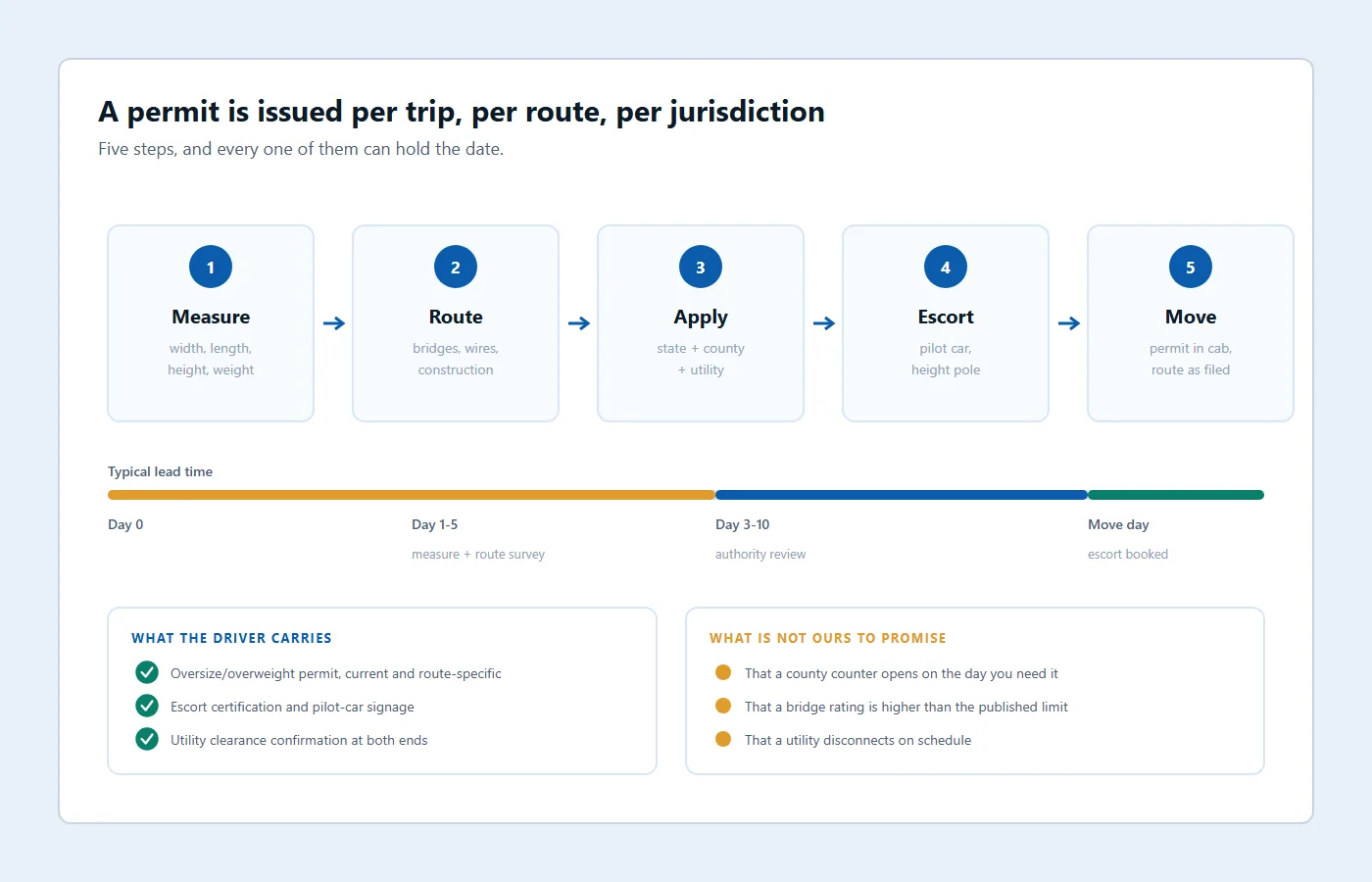
Mobile home transport permits: what the paperwork actually requires
Mobile home transport permits are issued per state, per route and per load, and the load’s dimensions decide which ones apply. These are the questions we answer before filing anything.
Who files mobile home transport permits?
We do, as the carrier, because the permit has to match the vehicle, the load and the route actually driven. Some states also require a local or county permit.
How long do mobile home transport permits take to issue?
Commonly one to three weeks, longer where the load exceeds a state’s standard oversize threshold and needs an engineering review.
What dimensions do mobile home transport permits depend on?
Loaded width, height, length and weight, measured with the home on the trailer. A home measured on its piers gives the wrong answer.
Do mobile home transport permits cover escorts?
The permit states when escorts are required; it does not provide them. Escort vehicles are booked separately and priced per mile and per day.
What happens if mobile home transport permits are not issued in time?
The move waits. Hauling without a valid permit exposes the carrier and the homeowner, and it can void insurance cover for the trip.
Are mobile home transport permits needed for a short move?
Usually yes, if the home is oversize at all. Travelling ten miles without a permit is the same offence as travelling a hundred.
Do mobile home transport permits expire?
Yes, and the validity window is short. A permit issued for one week does not cover a move that slips into the next.
Mobile home transport permits in short
- Mobile home transport permits are issued per state, per route and per load.
- Loaded dimensions decide which mobile home transport permits apply.
- Mobile home transport permits do not include escort vehicles.
- Superload review can extend mobile home transport permits by weeks.
- Mobile home transport permits expire, so a slipped date needs a new one.
- Hauling without valid mobile home transport permits can void insurance.
- Some jurisdictions require a local permit alongside mobile home transport permits.
State thresholds and escort rules are published by each state’s oversize permit office, within the national framework set out by the Federal Highway Administration. If you want the county-level picture for your route, our service areas page explains how we confirm it.