


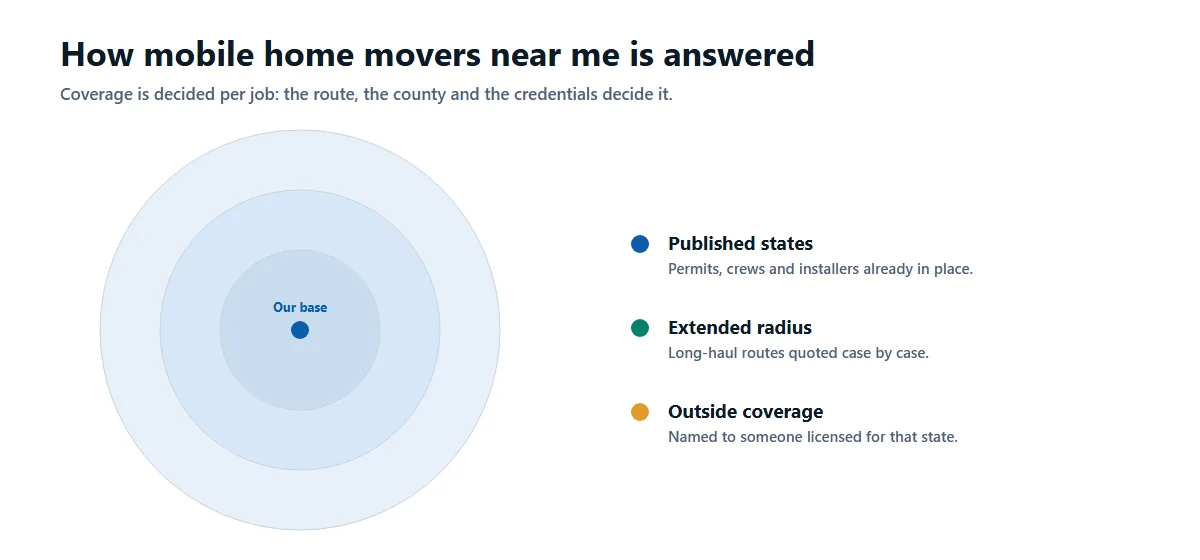
Looking for mobile home movers near me usually comes down to one question: who can legally haul and set a home at this address? We move and set manufactured homes locally and along the interstate corridors we know well. Coverage is not a sales claim — it is the list of places where we can legally perform the work, get permits through, and put our own crew on the site.
Table of Contents
Part of our services. This page is one of six that sit under the services overview, where the whole job is explained stage by stage.
Below is how coverage works, what changes from state to state, and how to tell an operator with local knowledge from a national landing page. If you are searching for mobile home movers near me, the section on signals is the one worth reading first.
How coverage works
| Zone | What we do there | Typical lead time |
|---|---|---|
| Home region | Full service with our own transport and set crews, including same-week scheduling where permits allow | 1–3 weeks |
| Extended region | Full service on scheduled routes; transport and set crews mobilised together | 2–4 weeks |
| Interstate corridors | Transport plus installation coordination with a licensed local installer where required | 3–6 weeks |
| Outside coverage | We refer you rather than broker your job to a stranger | — |
What changes from state to state
Three things drive the differences in price and schedule, and all three are jurisdiction-specific:
- Oversize limits and escort rules. Width, height, length thresholds and the number of pilot cars required.
- Installation licensing. Some states license installers and require a certification filing; others leave it to local code offices.
- Inspection capacity. Rural jurisdictions can be fast or extraordinarily slow, and that governs your handover date.
Our permit page explains what we file, and the compliance guide covers the installation standards that apply once the home lands.
Building a state page that ranks
Each state page in this pack follows the same template: the state’s transport reality, the installation authority, local wind exposure, typical routes, a cost table, and the questions homeowners ask in that state. Duplicate the template, change the facts, and link back to the service pages. Do not publish a state page that only swaps the state name — that is the fastest way to be filtered as thin content.
Request coverage for your route
Send the origin and destination and we will confirm whether we can perform the work directly, coordinate a licensed local installer, or refer you. Ask about your route.
Finding reliable mobile home movers near me
Searching “mobile home movers near me” returns three kinds of result: national brokers with a local landing page, directories selling leads, and actual operators with trucks in the county. The difference is visible in about a minute.
| Signal | Operator | Broker or directory |
|---|---|---|
| Address and licence number | Published, checkable | Absent or a mailbox |
| Local project photos | Real homes, local landmarks | Stock imagery |
| Price structure | Itemised, with permit pass-through | “Call for quote” only |
| Who sets the home | Their own crew, named | “Vetted partners” |
| Answer to a technical question | Specific, with code reference | Deflected |
If you are searching mobile home movers near me and the site cannot tell you who holds the installer licence for your county, keep looking.
State-level differences that decide your schedule
Three variables make one state’s move cheaper or slower than another’s: the oversize thresholds and escort rules, whether the state licenses installers and requires a certification filing, and how quickly the local code office inspects. A state with fast permits and a slow inspection office is still a slow move.
When you search mobile home movers near me, the useful question is not “who is closest” but “who has done this in this county, with this code office”. That is the knowledge that keeps a schedule intact.
Why we publish coverage instead of claiming everywhere
Plenty of sites claim nationwide mobile home movers coverage and then broker the job to whoever answers. We list where we perform work ourselves and where we coordinate a licensed local installer, because a homeowner deserves to know which one they are buying.
If your route falls outside coverage, we will say so and refer you rather than take a deposit and improvise.
Coverage is a promise about capability, not a map graphic. Where we can perform the work, we do it with our own crews and our own licence. Where we cannot, we say so. That is a slower sales pitch and a much better move — and it is why the mobile home movers near me search that lands here tends to end in a booking rather than a referral to someone else.
Quick answers on coverage
- Do you travel? Yes, and mobile home movers near me searches outside our region get an honest referral rather than a brokered job.
- Any minimum? No minimum distance, though short moves carry a mobilisation charge.
- Why not list every city? Because mobile home movers near me results should reflect real coverage, not a keyword list.
How coverage actually works in this trade
“Nationwide” is the most overused word in this industry. A company can legally move a home across the country and still be unable to set it legally at the other end, because installation is licensed by the state and inspected by the county. Coverage therefore has two layers, and they are not the same.
Transport coverage
- Permitted hauling across state lines
- Federal motor carrier authority
- State permits filed per segment
- Escorts arranged on the route
- Delivery to the site
Installation coverage
- Licensed to set in that state, where required
- Knowledge of the county’s amendments
- Local inspection relationships
- Wind zone and anchoring practice
- Utility coordination and close-out
Where we hold installation credentials, we do the whole job with our own crew. Where we do not, we say so and either coordinate a licensed local installer or decline the installation. What we will not do is take your money for a set we cannot legally perform and hand it to someone you have never spoken to.
What changes from state to state, in plain terms
| Variable | Why it changes | What it does to your schedule |
|---|---|---|
| Permit ceiling and fees | Each state sets its own width, height and length limits and its own fee schedule | A load legal in one state may need a superload review in the next |
| Escort thresholds | Triggered by different combinations of width, length and route type | Adds vehicles, days and cost to the quote |
| Travel windows | Night, weekend and holiday restrictions are local | A legal load can still be illegal at the wrong hour |
| Installer licensing | Some states license installers, others license the business | Determines who can sign the certification |
| Inspection regime | County or state, with local amendments to the federal standard | Determines what documentation you need at handover |
| Wind zone assignment | Coastal and high-wind counties carry stricter requirements | Can determine whether a specific home may be sited at all |
| Title and conversion rules | Vehicle title versus real property | Affects financing, insurance and resale |
What we need before we can confirm your area
Coverage is confirmed per job, not per postcode, because two addresses in the same state can have completely different requirements. To tell you whether we can do the work, we need four things.
- The origin address and county — access, park rules and the local permit office.
- The destination address and county — zoning, wind zone, utility availability and inspection regime.
- The home’s dimensions and section count — the load decides the route and the escorts.
- Your target dates — permit lead times vary through the year, and peak season is real.
Cities and towns: why we do not publish a page for each one
You have seen the pattern: a mover with a page for every town within two hundred miles, each one the same paragraph with the name swapped. It exists to catch a search, not to help a customer, and Google has become good at recognising it.
We publish state-level guidance because that is where the rules actually change. Within a state, what changes is the county — the permit office, the inspection regime, the zoning — and we handle that in the quote rather than in a paragraph of recycled copy.
If you cannot find your town on this page, that is not a no. Send the address and we will tell you within a business day whether we can perform the work ourselves, coordinate a licensed local installer, or point you to someone who can. A straight answer is more useful than a page that pretends to cover everywhere.
Working with a park, a dealer or a developer
Much of the work in this trade arrives through a third party: a park manager approving a home, a dealer selling one that has to be delivered, a developer phasing a community. Each has a different question.
- Park managers want to know the home will meet the community’s standards, that the set will pass inspection, and that the crew will not damage the roads.
- Dealers want a delivery date they can promise a buyer, and documentation that satisfies the lender.
- Developers want a phase schedule, per-unit records, and one point of contact.
All three want the same thing underneath: a crew that turns up when it says it will, does the work to the standard, and leaves a file behind. That is the product, whatever the address.
Regional differences worth knowing before you book
The rules that matter to a homeowner cluster by region rather than by state line, and knowing the cluster tells you what to expect from the schedule.
| Region | What tends to be stricter | What that does to your timeline |
|---|---|---|
| Coastal Southeast | Wind zone assignment, anchor patterns, floodplain siting | Engineering review can precede the permit |
| Gulf Coast | High-wind anchoring and elevation requirements | Longer inspections, more documentation |
| Midwest | Frost depth, footing requirements, spring load limits on roads | Seasonal windows; spring thaw can close routes |
| Mountain West | Snow load, access grades, long permit distances | Longer hauls, fewer legal corridors |
| Northeast | Older infrastructure, low clearances, tight municipal review | Route surveys matter more than distance |
| Southwest | Soil conditions, heat restrictions on some materials | Site work sequencing shifts to cooler hours |
None of this is a substitute for the county’s answer on your specific parcel. It is the context that tells you which question to ask. \quickcode
Moving into a park, and moving out of one
Parks are their own jurisdiction. The county decides whether the home may be sited; the park decides whether it may be sited there, and the two answers are independent.
Moving in
- Get the park’s written approval for the specific home, including age, size and appearance standards.
- Confirm who is responsible for the pad, the utility stubs and the tie-downs — it varies by park.
- Ask about the move-in window: many parks restrict heavy vehicle access to certain hours.
- Ask whether the park requires its own inspection in addition to the county’s.
Moving out
- Read the lease for notice periods and any restoration obligation on the lot.
- Confirm the utility disconnects and who requests them.
- Photograph the lot condition before and after, because deposits are settled on evidence.
The one question that stops most park moves: does the park’s approval expire? A home approved in March and delivered in July can arrive to a changed rule or a new manager. Get the approval dated and confirm its validity in writing.
Cross-border and long-distance coordination
When the origin and the destination are in different states, three things have to be coordinated rather than assumed: the permit set, the installation credentials and the inspection regime. We handle the first directly, confirm the second per state, and tell you what the third will require before the home arrives.
- Route plan. State segments, escort thresholds per segment, and travel windows per jurisdiction.
- Permit filings. Filed per state, matched to the route actually driven.
- Installation credentials. Confirmed for the destination state, with the licensing basis stated.
- Inspection expectations. What the destination county will require, and what documentation satisfies it.
If any of the four cannot be confirmed, we say so before the deposit rather than after the home is loaded. The permit guide explains the filing side in detail, and the Federal Highway Administration publishes the national framework the state rules sit inside.
Confirming coverage in one email
Send four lines and you will get a yes, a no, or a referral within a business day.
- The origin address or county.
- The destination address or county.
- The home: year, length, width, sections.
- The target window.
That is enough to know whether the job is one we can perform with our own crew, one we would coordinate with a licensed local installer, or one we should decline. A short answer early is worth more than a long proposal that ends in a subcontractor you have never met. If you would rather talk it through, the contact page lists what we need for a firm quote.
Finding mobile home movers near me: how to tell them apart
Searching for mobile home movers near me returns a long list that looks identical, and the differences are in the paperwork rather than the website. These are the questions that separate mobile home movers near me who can finish a job from those who broker it.
How do I check that mobile home movers near me are licensed?
Ask for the licence number and verify it with the state. Mobile home movers near me who cannot produce a verifiable number are not licensed to set your home.
Do mobile home movers near me handle permits?
The good ones do. Mobile home movers near me who leave permits to the customer are transport-only, and the permit is what makes the haul legal.
Why do mobile home movers near me quote such different prices?
Scope, not efficiency. Mobile home movers near me who exclude the set, anchors or escorts are cheaper because the work is missing, not because it is done better.
Can mobile home movers near me move a home out of a park?
Yes, with the park’s approval and the utility disconnects arranged. Mobile home movers near me who have worked the local parks know the access constraints.
How far will mobile home movers near me travel?
Ask before you assume. Some cover a few counties, others run interstate. Mobile home movers near me who subcontract long hauls should say so plainly.
What should mobile home movers near me provide at handover?
Level readings, the anchor pattern, photographs, permits and the certification. Mobile home movers near me who hand over a file are accountable for the work.
How do I compare mobile home movers near me fairly?
Rewrite each quote into the same eleven questions, then compare. Mobile home movers near me who answer all eleven are quoting the same job as each other.
Coverage is confirmed per job rather than per postcode, because the county rules change what the work involves. If the answer is that we are not the right mobile home movers near me for your address, we will say so and point you to someone who is.
Mobile home movers near me, in short
- Mobile home movers near me should be licensed for the state the home lands in.
- Mobile home movers near me who exclude permits are transport-only.
- Mobile home movers near me should confirm access before quoting.
Coverage is confirmed per job, and the answer is usually yes inside our published states and sometimes yes outside them for a full-scope move. If the honest answer is that we are not the right mobile home movers near me for your address, you will get that answer in the first reply rather than after a deposit.